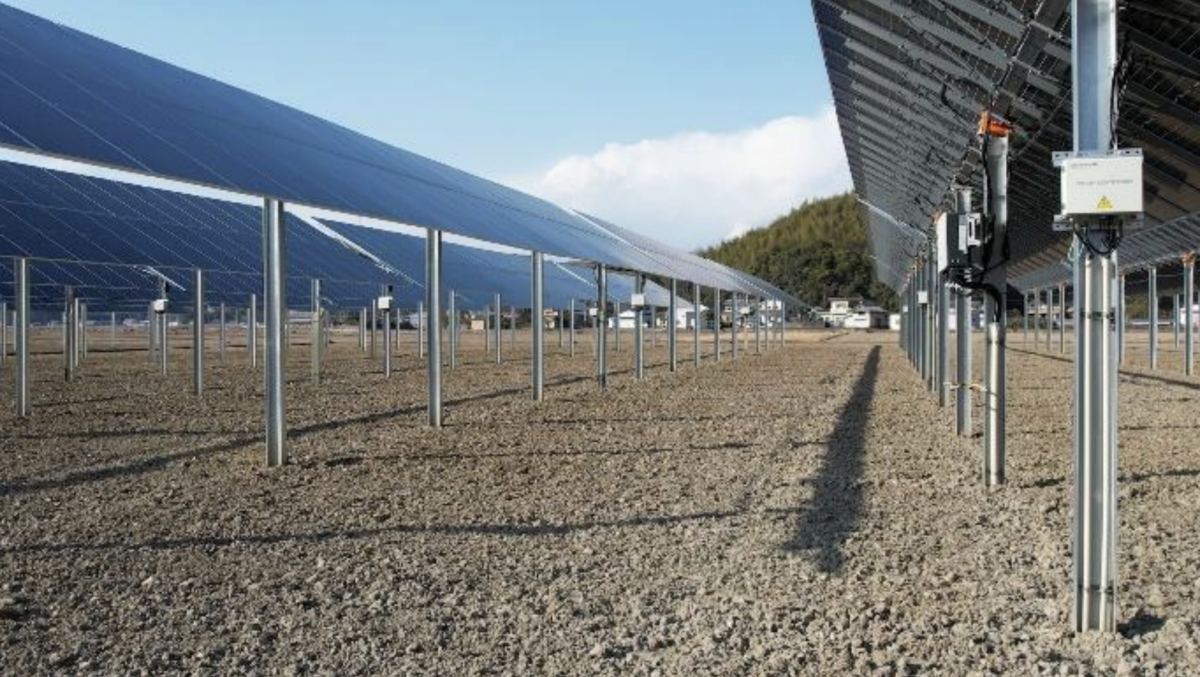





Tokyo-headquartered Idemitsu Kosan has begun operating a 2 MW agrivoltaics project in Japan.
The Idemitsu Tokushima agricultural solar power plant is deployed on top of a rice paddy in Komatsushima City within Japan’s Tokushima Prefecture.
Idemitsu says the array is one of Japan’s largest agrivoltaic projects to date. It first announced plans to build the site in January 2025 after the successful conclusion of a 45 kW pilot project located at a rice field in Chiba Prefecture.
Join us on March 5 for the Dual harvest, double trouble: Tackling EPC barriers in agrivoltaics design pv magazine session in English language at KEY – The Energy Transition Expo in Rimini. Experts will share insights on current agrivoltaic technologies, key design choices and the main barriers to standardized, scalable dual‑use projects in Europe and Italy, including region‑specific EPC issues. The newly-inaugurated array features a system developed by Yokohama-based Clean Energy Japan Co. Ltd, which combines a movable mounting system that automatically controls the angle of its bifacial solar panels in accordance with the sun. “During the growing season, mainly April to August, sunlight is prioritized on the rice under the panels to ensure the environment necessary to maintain yield and quality, while the backside light of the bifacial module is also utilized to compensate for the decrease in power generation,” the company said in a statement. “During the non-growing season, operation switches to prioritize sunlight on the panel.” The installation stands at 3.8 meters above the rice paddy, allowing agricultural machinery to continue working underneath. Idemitsu added that the project returns a portion of the profits from power generation to the farmers as land rent. “By doing so, we will contribute to securing stable income for farmers and improving the sustainability of agricultural management, and will also address issues such as aging and a lack of successors,” the company said. “This will help solve agricultural and local community issues such as foot traffic and the increase in abandoned farmland.” Idemitu’s latest statement adds that utilitzing around 5% of the country's farmland for power facilities would generate approximately twice the installed capacity of the solar facilities currently operating in Japan. “It is estimated that this will be possible, and we will contribute to the expansion of renewable energy as well as strengthening energy security by securing domestic energy,” the company said, before adding that it will work to popularize and expand agricultural solar power generation while building and expanding collaborative schemes. While agrivoltaics remain in their relative infancy in Japan, after authorities previously decided to suspend incentives for over 300 projects, research has pointed to potential benefits of the technology. Last April, scientists from the University of Tokyo found agrivoltaics can support productivity in rice plantations. Research from last August added that double-axis tracking may be the most suitable technology for such installations. The Japan Photovoltaic Energy Association released a voluntary reference guide to vertical bifacial PV last month, including safety measures and land-sharing approaches for agricultural installations. This content is protected by copyright and may not be reused. If you want to cooperate with us and would like to reuse some of our content, please contact: editors@pv-magazine.com.



By submitting this form you agree to pv magazine using your data for the purposes of publishing your comment.
Your personal data will only be disclosed or otherwise transmitted to third parties for the purposes of spam filtering or if this is necessary for technical maintenance of the website. Any other transfer to third parties will not take place unless this is justified on the basis of applicable data protection regulations or if pv magazine is legally obliged to do so.
You may revoke this consent at any time with effect for the future, in which case your personal data will be deleted immediately. Otherwise, your data will be deleted if pv magazine has processed your request or the purpose of data storage is fulfilled.
Further information on data privacy can be found in our Data Protection Policy.