




From pv magazine Spain
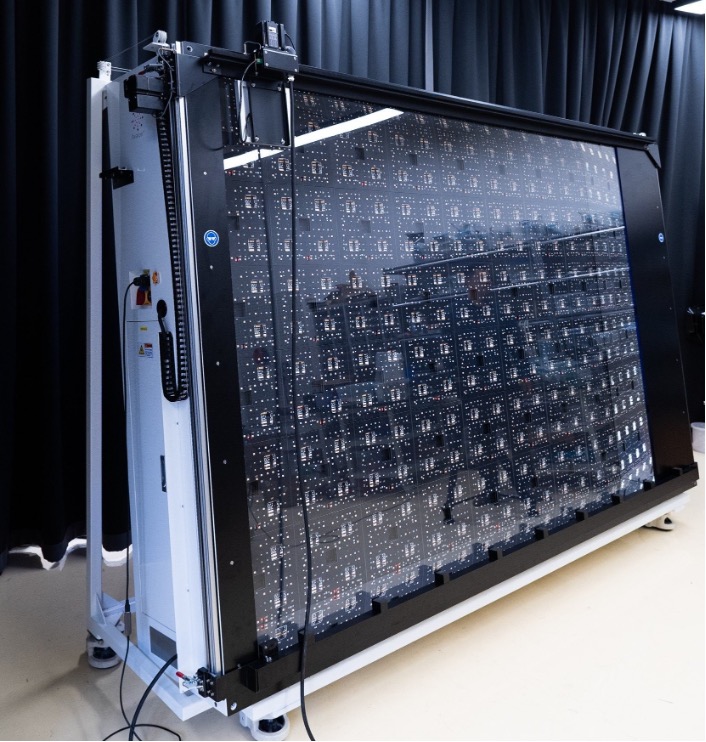
Spain's Center for Energy, Environmental and Technological Research (CIEMAT) has commissioned a state-of-the-art large-area solar simulator designed for the electrical characterization of commercial photovoltaic modules and the experimental study of emerging PV technologies, the institute told pv magazine.
Developed by the Photovoltaic Solar Energy Unit at CIEMAT, the new system enables high-precision current-voltage (I-V) measurements under tightly controlled irradiance, spectral distribution, and temperature conditions. The simulator is specifically designed for testing full-size commercial PV modules while providing flexibility for research on next-generation technologies.
At the core of the system is a multispectral LED array composed of emitter modules arranged on 15 cm × 15 cm plates that cover the entire module test area. The configuration includes 37 LED types and 32 independently controlled spectral channels, allowing the system to closely reproduce the solar spectrum.
According to CIEMAT, the simulator achieves spatial irradiance uniformity better than 0.4%. It can also generate illumination pulses of up to 500 ms. Combined with dynamic I-V acquisition, this capability allows accurate testing of photovoltaic modules with high electrical capacitance in a single pulse.
The combination of long pulse duration, dynamic voltage sweep control, and high temporal stability enables precise characterization of modern high-efficiency modules, according to the institute. Independent spectral channel control also allows researchers to optimize spectral matching for different photovoltaic technologies, including crystalline silicon, heterojunction (HJT), PERC, TOPCon, perovskites, and thin-film devices.
CIEMAT notes that this multispectral LED approach offers improved spectral matching compared with conventional solar simulators based on xenon lamps.
The system incorporates a high-speed acquisition platform capable of performing dynamic I-V curve sweeps during the illumination pulse, simultaneously recording current and voltage. From these measurements, the simulator determines key electrical parameters of photovoltaic modules, including short-circuit current, open-circuit voltage, maximum power, maximum power point (MPP), and fill factor (FF).
The equipment also supports irradiance and temperature corrections in accordance with procedures defined in IEC 60904-9.
Based on its measured performance, the simulator achieves a classification of A+++ / A++ / A+++ under IEC 60904-9 criteria for solar simulators. The classification evaluates three key parameters: spectral match, spatial uniformity, and temporal stability.
CIEMAT said the simulator’s performance exceeds the requirements for Class A devices, placing it among the most accurate solar simulation systems currently available.
The simulator is also integrated with a large-volume thermal chamber that enables module testing across a wide temperature range. This configuration allows researchers to perform electrical characterization under controlled thermal conditions.
The setup supports studies of module temperature coefficients, variations in maximum power point with temperature, and electrical behavior under representative operating conditions.
According to CIEMAT, combining the solar simulator with temperature-controlled testing infrastructure provides a powerful experimental platform for evaluating photovoltaic module performance under conditions that closely replicate real-world field operation.
This content is protected by copyright and may not be reused. If you want to cooperate with us and would like to reuse some of our content, please contact: editors@pv-magazine.com.

By submitting this form you agree to pv magazine using your data for the purposes of publishing your comment.
Your personal data will only be disclosed or otherwise transmitted to third parties for the purposes of spam filtering or if this is necessary for technical maintenance of the website. Any other transfer to third parties will not take place unless this is justified on the basis of applicable data protection regulations or if pv magazine is legally obliged to do so.
You may revoke this consent at any time with effect for the future, in which case your personal data will be deleted immediately. Otherwise, your data will be deleted if pv magazine has processed your request or the purpose of data storage is fulfilled.
Further information on data privacy can be found in our Data Protection Policy.