




The UAE installed approximately 1 GW of solar in 2025, according to analysis published by GlobalData. The UK-based consultancy says the UAE’s cumulative solar capacity went from 5.7 GW at the end of 2024 to around 6.7 GW by the end of 2025.
GlobalData is predicting around 2.4 GW of solar will be added this year, taking cumulative capacity to 9.4 GW by the end of 2026. Longer-term forecasts predict solar growth in the country will register a compound annual growth rate of over 17% until 2035, reaching 20 GW of solar by the end of decade and surpassing the 30 GW threshold in 2035. Meanwhile, solar PV generation is projected to rise from 15.8 TWh in 2025 to 75.4 TWh by 2035.
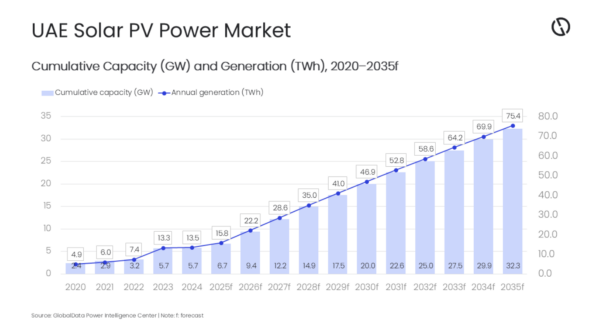
Image: GlobalData
Mohammed Ziauddin, Power Analyst at GlobalData, told pv magazine the UAE’s solar market expansion is being driven by a combination of structural advantages, long term policy frameworks, competitive procurement models, rapidly growing electricity demand and increasing deployment across commercial, industrial and distributed market segments.
He also said that competitive dynamics within the UAE’s solar sector are shaping market growth. “Chinese equipment manufacturers provide cost competitive photovoltaic modules and components, European developers actively participate in Independent Water and Power Producer (IWPP) tenders and state-backed Emirati utilities coordinate project procurement and power offtake,” Ziauddin explained, “This ecosystem has helped establish the UAE as one of the most competitive solar markets globally.”
Utility-scale solar currently dominates, and is forecast to continue leading, the UAE’s installed solar capacity, supported by the country’s large land availability and centralized electricity system. Leading projects include the Mohammed bin Rashid Al Maktoum Solar Park, billed as the largest single-site solar park in the world with an existing capacity around 3.8 GW, and the 2 GW Al Dhafra solar park, which was refinanced in January.
Ziauddin said the UAE's IWPP procurement model, which sees government utilities procure capacities through international tenders supported by long-term power purchase agreements, play a critical role in accelerating solar deployment. “This procurement structure reduces investment risk while attracting global developers and financing institutions. As a result, projects such as Al Dhafra Solar PV have achieved some of the lowest solar tariffs globally,” he explained.
The UAE’s commercial and industrial segment is expanding rapidly, Ziauddin added, with companies installing rooftop or carport solar systems to reduce electricity costs and industrial facilities, logistics centers, retail complexes, universities and data centers increasingly adopting onsite solar installations.
Ziauddin also said that while the residential market remains smaller compared to utility-scale deployments, rooftop solar installations are gradually increasing as technology costs decline and awareness of sustainability grows. “The distributed solar segment is also being supported by net metering policies,” he explained. “Programs such as [net-metering program] Shams Dubai allow households and businesses to install rooftop solar systems and export excess electricity to the grid.” Last month, the city of Abu Dhabi unveiled its own plans to support deployment of solar systems for self-consumption.
Ziauddin also noted that solar energy is increasingly integrated into infrastructure and industrial applications in the UAE, via solar-powered desalination, district cooling infrastructure, hybrid energy systems and solar-powered digital infrastructure such as data centres.
As its solar capacity increases, the UAE is expected to maintain grid stability through gas flexibility, nuclear baseload supply and storage additions. Ziauddin told pv magazine that based on indicative market estimates, the UAE’s cumulative battery storage capacity was around 518 MW in 2025 and is expected to rise to approximately 1.1 GW by 2030. Solar is being combined with battery storage in both grid connection and distributed applications, Ziauddin said, in order to enhance reliability and reduce dependence on conventional generation.
Away from renewables, the UAE’s power system is anchored by gas and nuclear generation. GlobalData’s figures expect gas-fired capacity to expand from 44.4 GW in 2025 to nearly 46 GW by 2035, while nuclear capacity is forecast to remain stable at approximately 5.3 GW.
This content is protected by copyright and may not be reused. If you want to cooperate with us and would like to reuse some of our content, please contact: editors@pv-magazine.com.


By submitting this form you agree to pv magazine using your data for the purposes of publishing your comment.
Your personal data will only be disclosed or otherwise transmitted to third parties for the purposes of spam filtering or if this is necessary for technical maintenance of the website. Any other transfer to third parties will not take place unless this is justified on the basis of applicable data protection regulations or if pv magazine is legally obliged to do so.
You may revoke this consent at any time with effect for the future, in which case your personal data will be deleted immediately. Otherwise, your data will be deleted if pv magazine has processed your request or the purpose of data storage is fulfilled.
Further information on data privacy can be found in our Data Protection Policy.