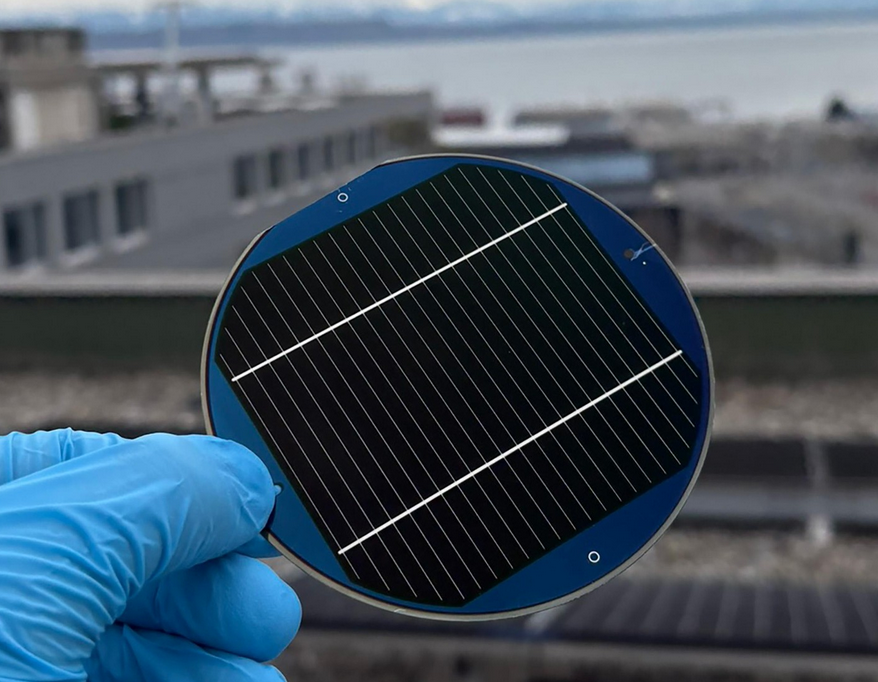





Researchers from the Swiss Center for Electronics and Microtechnology (CSEM) and the École polytechnique fédérale de Lausanne (EPFL) claim to have achieved a power conversion efficiency exceeding 30% for a triple-junction solar cells combining two thin-film perovskite cells and one silicon cell on a single device.
The result was certified by China's Shanghai Institute of Microsystem and Information Technology (SIMIT).
The scientists said the new result represents a world record for this cell technology, surpassing the previous record of 27.10% set by a research team led by National University of Singapore (NUS).
The researchers report having addressed two major challenges in triple-junction solar cells: low voltage in the top perovskite layer and limited current in the middle layer. They tackled these issues through three key modifications to the device’s materials and optical design.
First, they introduced a molecule that guides perovskite crystal growth and passivates defects, enabling the top cell to reach voltages of 1.4 V under sunlight. Next, they developed a novel three-step fabrication process for the middle cell, improving absorption of near-infrared light. Finally, they incorporated silicon oxide (SiOx) nanoparticles between the silicon bottom cell and the middle perovskite layer to reflect additional sunlight back into the middle cell, further boosting its current.
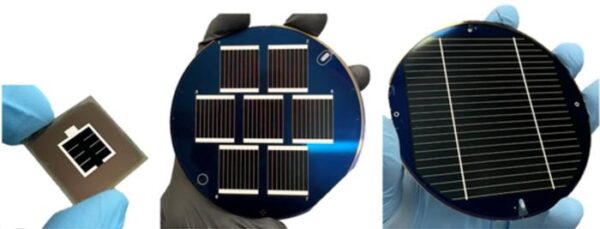
Image: EPFL
“We show that with clever design and processing, we can approach performance levels traditionally reserved for the most expensive III–V multi-junction solar cells used in space, which are composed of multiple semiconductor layers,” said the research's lead author, Kerem Artuk. “These can reach up to 37% efficiency, and cost around 1,000 times more than terrestrial cells per watt. Our approach opens the door to a new generation of industrially viable, high-efficiency multi-junction photovoltaics.”
“Our first demonstration in 2018 had only 13% efficiency, so reaching over 30% efficiency today in a triple-junction device is a remarkable achievement,” adds PV-Lab head Christophe Ballif. “Triple-junction solar cells have an even higher efficiency potential compared to single junction and tandem – well above 40%.”
The new cell device was introduced in the study “Triple-junction solar cells with improved carrier and photon management,” published nature.
The research team included academics from Germany’s Fraunhofer Institute for Solar Energy Systems ISE and Australia's University of Queensland, among others.
*The article was updated on March 19 to reflect that the efficiency result was validated by the Shanghai Institute of Microsystem and Information Technology (SIMIT).
This content is protected by copyright and may not be reused. If you want to cooperate with us and would like to reuse some of our content, please contact: editors@pv-magazine.com.



By submitting this form you agree to pv magazine using your data for the purposes of publishing your comment.
Your personal data will only be disclosed or otherwise transmitted to third parties for the purposes of spam filtering or if this is necessary for technical maintenance of the website. Any other transfer to third parties will not take place unless this is justified on the basis of applicable data protection regulations or if pv magazine is legally obliged to do so.
You may revoke this consent at any time with effect for the future, in which case your personal data will be deleted immediately. Otherwise, your data will be deleted if pv magazine has processed your request or the purpose of data storage is fulfilled.
Further information on data privacy can be found in our Data Protection Policy.