




A recent study by Germany’s Thünen Institute has raised questions about the economic viability and broader societal benefits of agrivoltaic systems, particularly those built with elevated mounting structures. High upfront costs combined with relatively low land-use efficiency often make such systems difficult to operate profitably without subsidies.
“While this criticism is valid in many respects, an important segment of agrivoltaics has so far received little attention in both the study and public discourse: systems mounted relatively low over crops or farmland, allowing farming activities beneath the panels,” Peter-Ludwig Gutberlet, project manager at German engineering company BEC Energie Consult GmbH, told pv magazine. “These systems differ fundamentally in their design, cost structure, and integration into agricultural operations, and may offer a pathway to economically viable agrivoltaics without financial support.”
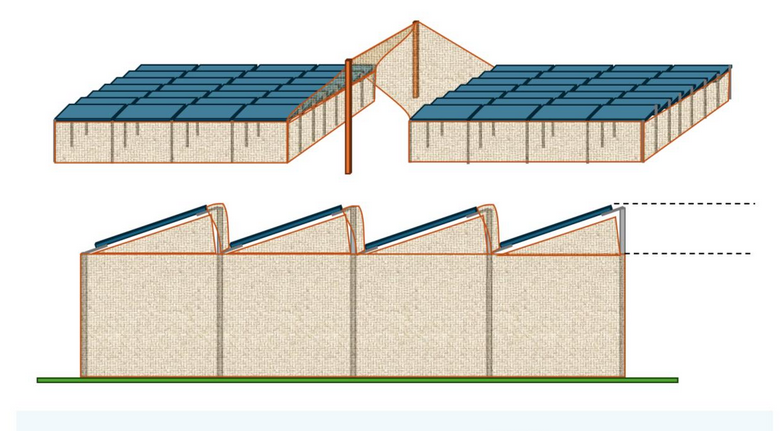
BEC Energie Consult has developed a mounting structure for ground-level agrivoltaics with heights ranging from 1.1 to 1.5 meters. The PV modules are supported by Magnelis-coated reinforcing steel bars with a diameter of 16 mm. “Instead of conventional row layouts, the modules are arranged in flexible block units,” Gutberlet said. “This design significantly reduces material usage while enabling high installed capacity per hectare. At the same time, it creates favorable conditions for plant growth beneath the system.”
The company cites structure costs ranging from €0.03 ($0.035)/W to €0.04/W, with installed capacity of 1.3–1.6 MW per hectare. “For a 5 MW project, this translates into substructure costs of around €200,000, compared to €600,000 for a 2.1-meter elevated system and €900,000 for a 4-meter design,” Gutberlet explained. “Land-use efficiency further strengthens the business case: assuming a lease rate of €3,000 per hectare per year over 20 years, the land cost per megawatt is approximately €40,000 for the BECU system, compared to €60,000 and €75,000 for the higher-mounted alternatives.”
A key feature of the system is the spacing between modules – 15 centimeters horizontally and 10 centimeters vertically. These gaps ensure each module has its own drip edge, allowing angled rainfall to distribute evenly beneath the installation. Diffuse light also passes through, improving conditions for vegetation below. Minimal soil sealing and the stable microclimate created by the low installation height further support plant growth, the company says.
“The advantages are particularly evident in livestock applications, especially free-range poultry farming,” Gutberlet said, noting that, in conventional systems, chickens tend to stay close to the barn due to predation risk, leading to uneven land use, vegetation loss, and increased disease pressure. “The low-mounted agrivoltaic structure provides protection from birds of prey while creating shaded areas with improved microclimatic conditions. Animals make greater use of the available space, vegetation can recover, and overall farm management improves. The dense arrangement of reinforcing bars further limits predator access, enhancing the protective effect.”
Economically, the system may benefit farmers in several ways. “Additional income streams from land leasing or participation models, reduced livestock losses, and potentially improved product quality,” Gutberlet stated. “With animals accessing a more diverse diet including grasses, herbs, and insects, early practical experience suggests product quality may improve. The system’s flexible design also allows adaptation to operational requirements, for example leaving pathways for mobile poultry housing.”
A recent project illustrates the proposed approach. Designed under Germany’s agrivoltaic regulations, the installation has a capacity of 3.5 MW and covers 2.5 hectares of PV modules, with 1.35 hectares directly shaded. The total planning area extends to 4.33 hectares to accommodate farm operations. Substructure costs totaled €140,000. According to the developer, the project could compete under current tender conditions without additional subsidies.
“While elevated systems often face justified criticism, low-mounted concepts such as the BECU substructure demonstrate that economically viable solutions may already exist,” Gutberlet concluded. “They combine cost-efficient electricity generation with continued agricultural use, while delivering benefits for animal welfare and land management. The key question, therefore, is not whether agrivoltaics makes sense, but which system design can best meet both economic and agricultural needs.”
This content is protected by copyright and may not be reused. If you want to cooperate with us and would like to reuse some of our content, please contact: editors@pv-magazine.com.


By submitting this form you agree to pv magazine using your data for the purposes of publishing your comment.
Your personal data will only be disclosed or otherwise transmitted to third parties for the purposes of spam filtering or if this is necessary for technical maintenance of the website. Any other transfer to third parties will not take place unless this is justified on the basis of applicable data protection regulations or if pv magazine is legally obliged to do so.
You may revoke this consent at any time with effect for the future, in which case your personal data will be deleted immediately. Otherwise, your data will be deleted if pv magazine has processed your request or the purpose of data storage is fulfilled.
Further information on data privacy can be found in our Data Protection Policy.