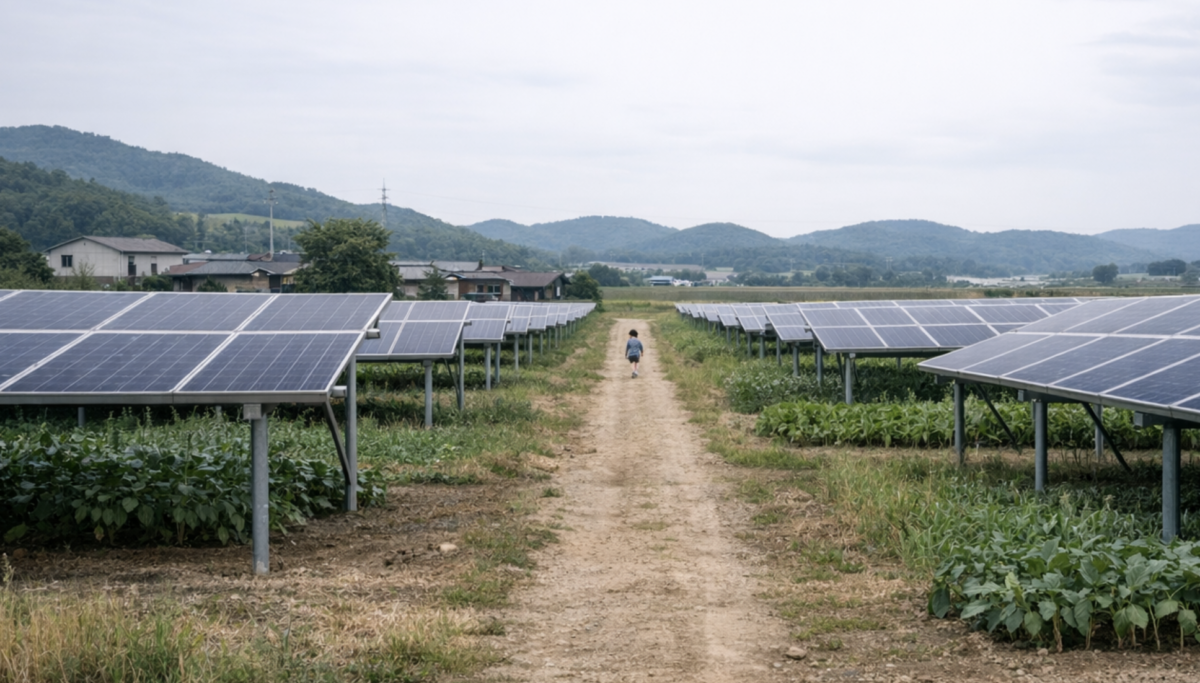





South Korea's Ministry of the Interior and Safety (MOIS) has announced a public competition opening at the end of March for its Sunlight Income Village program, under which rural village communities form cooperatives to install and operate solar power plants on idle local land and share the revenue among residents. More than 500 villages are to be selected this year, with applications to be accepted in two rounds – the first closing at the end of May, the second at the end of July.
The program targets more than 2,500 villages by 2030, drawn from approximately 38,000 administrative villages nationwide. Individual installations are sized at 300 kW to 1 MW, centered on public land, village land, reservoirs, and reserve farmland. Use of domestically produced modules and inverters is mandatory.
The MOIS is leading the program in cooperation with the Ministry of Agriculture, Food and Rural Affairs (MAFRA) and the Ministry of Climate, Energy and Environment (MCEE), supported by a public-private joint field support team that includes Korea Electric Power Corp. (Kepco), the Korea Energy Agency, the Korea Rural Community Corporation (KRC), and the Korea Water Resources Corp. (K-water).
The team, led by provincial governments, is scheduled to begin operations in April and will include on-site consulting for cooperative formation and an idle land survey by KRC and K-water to identify available sites.
Financing support covers long-term, low-interest loans for up to 85% of installation costs, drawn from approximately KRW 450 billion in renewable energy financial support available in 2026. In areas experiencing population decline, local governments may use a dedicated Local Extinction Response Fund to cover residents' remaining cost share. New renewable energy cooperatives and facilities are eligible for acquisition tax exemptions and property tax reductions.
Grid connection – identified by the government as the program's largest obstacle – will be addressed through amendments to the Electric Utility Act and the Distributed Energy Special Act to grant Sunlight Income Village projects priority grid access. Energy storage system (ESS) installation support will be provided in parallel where grid capacity is insufficient.
The program builds on earlier community solar initiatives in South Korea. In Guyang-ri, a village in Yeoju, Gyeonggi province, a resident cooperative installed solar plants on village warehouses and parking lots and uses electricity sale revenue to fund free lunches at the community center and operate a free village bus.
South Korea has been moving on several solar policy fronts simultaneously in recent months. In February, the National Assembly amended the renewable energy framework to restrict local setback rules for PV projects, removing a permitting barrier that had long slowed deployment. The same month, the government announced KRW 321 billion in 2026 funding to upgrade regional distribution networks and deploy 85 energy storage systems. South Korea has also signaled it will introduce dedicated rules for agrivoltaics – a model relevant to the idle farmland the Sunlight Income Village program intends to use.
This content is protected by copyright and may not be reused. If you want to cooperate with us and would like to reuse some of our content, please contact: editors@pv-magazine.com.

By submitting this form you agree to pv magazine using your data for the purposes of publishing your comment.
Your personal data will only be disclosed or otherwise transmitted to third parties for the purposes of spam filtering or if this is necessary for technical maintenance of the website. Any other transfer to third parties will not take place unless this is justified on the basis of applicable data protection regulations or if pv magazine is legally obliged to do so.
You may revoke this consent at any time with effect for the future, in which case your personal data will be deleted immediately. Otherwise, your data will be deleted if pv magazine has processed your request or the purpose of data storage is fulfilled.
Further information on data privacy can be found in our Data Protection Policy.