





The Swiss photovoltaic market saw a significant contraction in 2025. While official figures will not be published until July, local association Swissolar association has revealed that newly deployed PV capacity for last year was down 15% compared to 2024. The announcement was made at the Swiss Photovoltaic Congress in Bern on March 31 and April 1, which attracted over 1,100 participants.
In 2025, Switzerland added 1,526 MW of new solar capacity, down from 1,798 MW in 2024 and 1,640 MW in 2023. “Following the surge in electricity prices in 2022, which strongly encouraged households to install solar panels, tariffs have since fallen, mechanically reducing this momentum,” said Wieland Hintz, Head of Market and Policy at Swissolar and newly appointed Deputy Director.
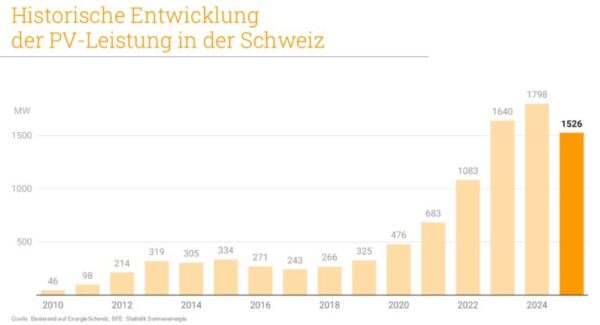
If these numbers will be confirmed, Switzerland would reach a cumulative installed PV capacity of 9.62 GW by the end of December 2025.
Despite the slowdown, the market shows signs of resilience. A survey of Swiss PV companies indicates that most expect higher revenue growth in 2026 than in 2025, with margins following a similar trend. Many companies also plan to expand their workforce, a development Swissolar describes as a sign of gradual recovery.
“Order books are stabilizing, which makes me cautiously optimistic,” said Matthias Egli, Director of Swissolar. “This development is largely driven by the growth of batteries, which are opening up new opportunities.” Residential storage, electric mobility, and building technology integration are driving momentum. The sector has evolved beyond rooftop or facade PV installations, becoming part of a broader building electrification strategy that integrates storage, smart solutions, and EV charging.
The association also revealed that behind-the-meter batteries in Switzerland now total 2,461 MWh, including 1,010 MWh installed in the past year, which is an 82% year-on-year increase. “Storage and smart management significantly reduce grid flows, both in withdrawal and injection. According to the Swiss Federal Office of Energy (SFOE), this could cut grid expansion costs by 20–60%,” said Jürg Grossen, National Councillor and President of Swissolar.
Solar power’s share of Switzerland’s electricity mix is rising. Swissolar forecasts that by 2026, solar will provide 17% of the country’s net electricity consumption, which is nearly half the output of the national nuclear fleet. Coordinating PV production with storage and consumption patterns will be essential to managing this growth.
Market volatility is also increasing, with hours of negative prices on the day-ahead market projected to rise from fewer than 100 in 2023 to around 300 in 2025. “The PV sector must now adapt to market signals,” said Leo-Philipp Heiniger, renewable energy specialist at the Swiss Federal Office of Energy (SFOE).
This content is protected by copyright and may not be reused. If you want to cooperate with us and would like to reuse some of our content, please contact: editors@pv-magazine.com.


By submitting this form you agree to pv magazine using your data for the purposes of publishing your comment.
Your personal data will only be disclosed or otherwise transmitted to third parties for the purposes of spam filtering or if this is necessary for technical maintenance of the website. Any other transfer to third parties will not take place unless this is justified on the basis of applicable data protection regulations or if pv magazine is legally obliged to do so.
You may revoke this consent at any time with effect for the future, in which case your personal data will be deleted immediately. Otherwise, your data will be deleted if pv magazine has processed your request or the purpose of data storage is fulfilled.
Further information on data privacy can be found in our Data Protection Policy.