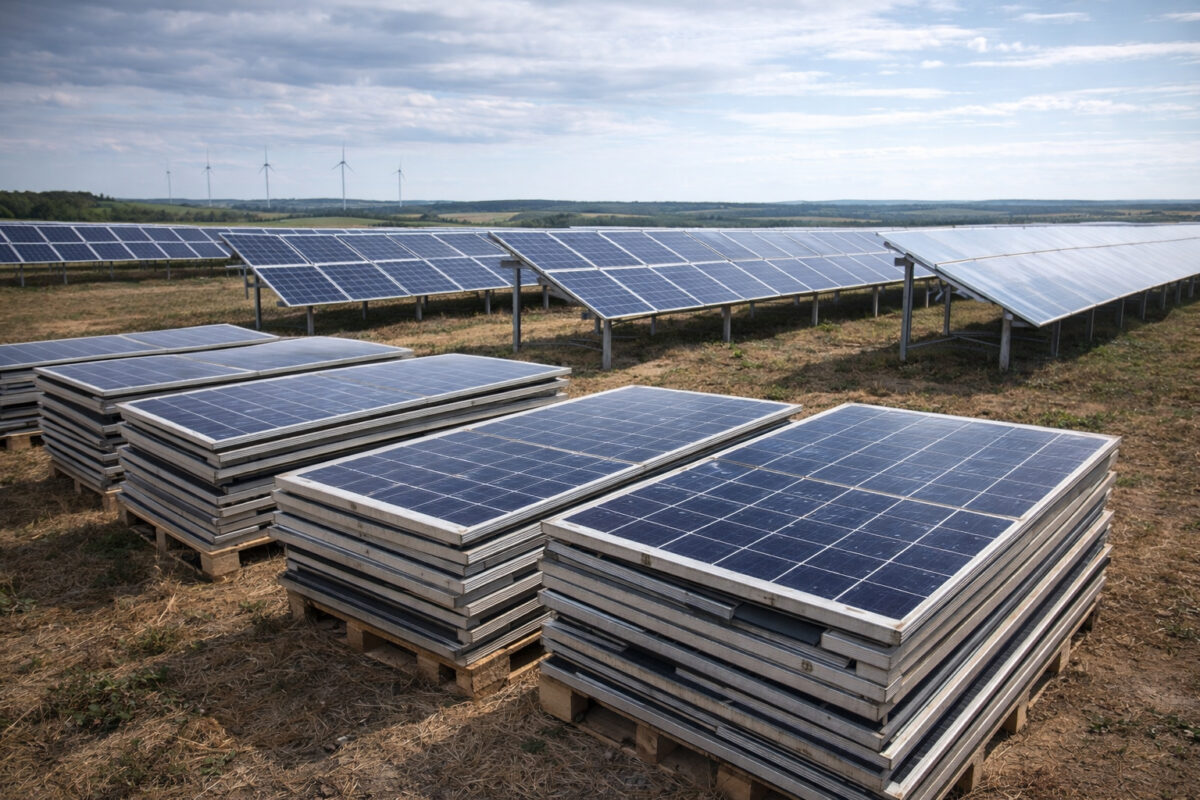





A Chilean research team has developed a residential-scale system to produce green hydrogen using discarded photovoltaic modules.
The proposed solution combines end-of-life solar panels that still retain 80% to 90% of their original capacity with a proton exchange membrane (PEM) electrolyzer. Unlike conventional systems, which rely on power electronics such as inverters or maximum power point trackers, the approach uses internal reconfiguration of the PV module to match its current-voltage curve to the electrolyzer’s requirements. This removes the need for additional components and reduces system complexity, the scientists explained.
The system configuration modifies the panel’s electrical architecture by connecting subsets of cells in parallel, enabling more efficient coupling with the electrolyzer. “By accessing internal busbars to create custom parallel substrings, this voltage-matching strategy can be generalized to other standard architectures, such as 60-cell or 96-cell modules,” the research team said. “This flexibility allows the system to overcome the heterogeneity of waste panels, enabling customized voltage matching and the isolation of localized cell failures across various PV technologies.”
According to the researchers, the system achieves an annual energy yield equal to 88% of that obtained with power electronics-based optimization, while maintaining operational simplicity, which is a key advantage for residential use.
Experimental results, validated under real-world conditions, show daily hydrogen production of around 345 liters. This significantly exceeds the estimated baseline demand for basic household uses such as cooking or heating, which is approximately 120 liters per day. The system achieves a solar-to-hydrogen efficiency of about 7%, capturing more than 70% of the theoretical maximum for simplified configurations.
From an economic perspective, the system delivers a levelized cost of hydrogen (LCOH) of approximately $5.8/kg, representing an 18% reduction compared to more complex reference systems. The cost advantage is primarily due to the elimination of power electronics and the reuse of existing PV modules.
The researchers say the concept could help address two challenges simultaneously: the growing volume of photovoltaic waste and the high cost of green hydrogen. Reusing panels extends their service life and reduces pressure on raw material supply chains.
However, the authors note limitations, including lower efficiency compared to systems with advanced electronic control and dependence on variable solar irradiance. Despite this, they consider the system’s simplicity, low cost, and ease of integration to make it a promising option for decentralized applications.
The work, titled “Green hydrogen production using discarded photovoltaic panels for domestic application,” is published in Energy Conversion and Management.
This content is protected by copyright and may not be reused. If you want to cooperate with us and would like to reuse some of our content, please contact: editors@pv-magazine.com.

What benefit will this give over going electric with some battery storage?
At 345L/day, assuming ‘Normal’ litres, that’s 30.8g H2/day or 1.21KWh.
At $5.8/Kg, this works out to about 14.7cents/KWh. Gas hob is about 40% efficient so the cost of heating the food is about 36.8cents/KWh. Also, article doesn’t state whether this includes the cost of storage.
Sun to cooking efficiency:
= 7% x 40% = 2.8%
If the PV panels are at 80% of new output they should have a sunlight to electricity efficiency of about 15% electric hob is about 80% efficient comma induction hob can be 90% plus the rain trooperation see for battery storage is about the same.
Sun to cooking efficiency:
= 15% x 80% x 90% = 10.8%,
This is 3.86x higher efficiency than H2 stove
It is also much safer and no NOx fumes.
Amortised cost of battery storage ≈ 2cents/KWh, bare cells now ~$50/KWh and 8,000 cycles.
This might have made an interesting research project, but the economics don’t stack up against battery storage and an electric hob.
Assuming that the majority of the cost for the hydrogen option is due to the electrolysis system, as the panels are second hand, the electric option is probably going to be between 5 and 10 times cheaper per KWh of energy used to heat the food, the hydrogen will be about 3x, possibly more, the cost of the electricity per kilowatt hour, and the stoves need about either 2 KWh of hydrogen or 1 KWh of electricity.
Additionally, if you’ve got electricity it’s going to be a lot easier to have light as well as heat.
These sorts of projects say to me that part of the foundation course for any STEM degree course really needs to include understanding ‘Whole Systems Critical Thinking/Analysis’.
Typo in my comment
“… plus the rain trooperation see”
Should be:
“… plus, and the round trip efficiency”