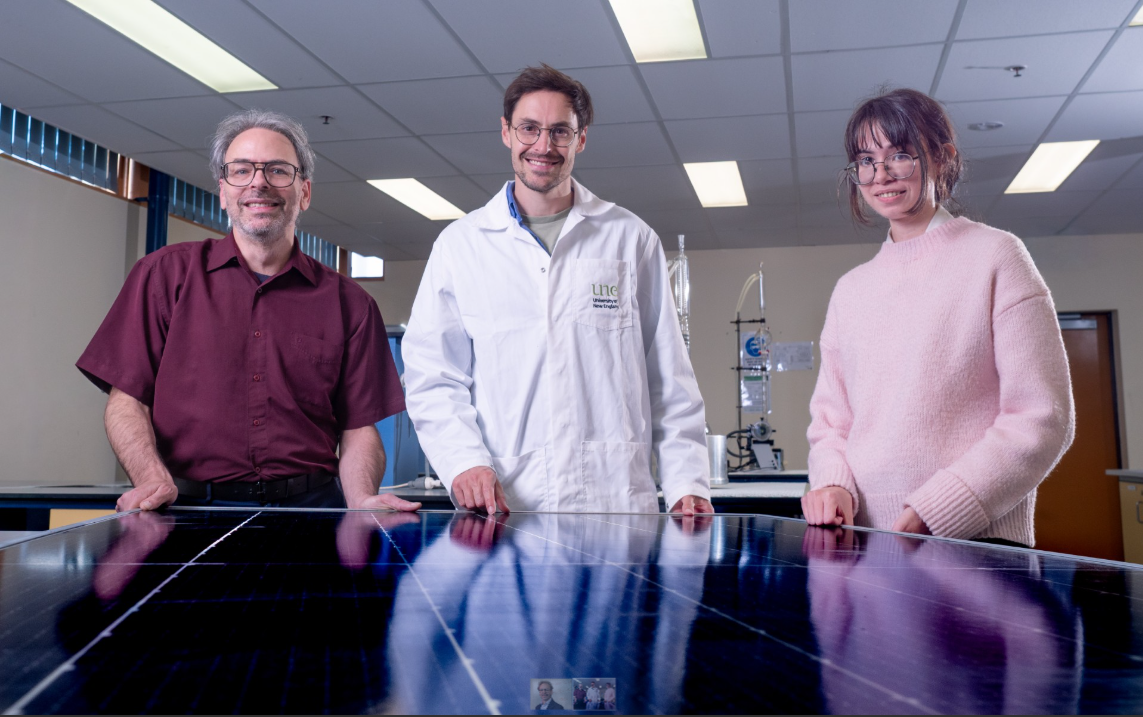





Researchers from the University of New England and the Australian Institute for Strategic Artificial Intelligence are using artificial intelligence (AI) and supercomputers to develop methods for recycling silicon wafers with minimal contamination.
Silicon, currently the most valuable component in a solar panel, cannot be recycled to its original purity because of the substrates used to prevent degradation during a panel’s operating life. The researchers are using AI-driven quantum chemical simulations to identify molecular solvent formulations capable of cleanly separating silicon from wafers. The simulations evaluate chemical efficacy, identify new pathways, and guide subsequent computations.
UNE computational chemist Kasimir Gregory said it is now possible to predict how panels can be disassembled at the molecular level. “These technologies are giving an exponential boost to the process of scientific discovery,” Gregory said.
Research colleague and ISA director Amir Karton said the team has created an efficient feedback loop between AI-driven predictions and experimental observations. “This allows us to actively steer the experimental discovery of optimal recycling pathways at unprecedented speeds,” Karton said.
The project is supported by a AUD 2.7 million ($1.9 million) automated robotic laboratory funded by the Australian Research Council and shared by several institutions. The laboratory can physically produce the solvents and materials identified through AI-driven simulations.
It can then test them in real-world experiments powered by agentic AI – autonomous AI agents capable of independently running experiments and managing workflows with minimal human intervention. The agents operate continuously, reducing development times from years to months.
The research has attracted support from Philippines-headquartered renewable energy developer ACEN Australia, which is supplying panels from its 720 MW New England Solar Project in the New South Wales Northern Tablelands.
Managing Director David Pollington said the company’s recently commissioned Stubbo Solar Project is the first large-scale project to achieve Circular PV Alliance certification, adding that the UNE research is “an important step in further improving the effectiveness and efficiencies of recycling processes.”
“We are also committed to supporting the regions in which we operate, so we’re extra excited that this industry-leading research is happening right here in the New England,” Pollington said.
Australia’s cumulative volume of end-of-life solar panels is expected to reach one million tonnes by 2035, with the material value of those panels projected to exceed AUD 1 billion.
“It is not practical to ship thousands of tonnes of solar waste across the country for processing,” Amir Karton said. “The university has a strategic focus on ensuring the renewables rollout here provides maximum benefit to the region while it benefits the nation.”
On May 7, 2026, UNE launched the Institute for Strategic Artificial Intelligence, operating within LabNext70, Australia’s first purpose-built AI research and delivery hub focused on education.
The institute is co-directed by Associate Professor Aaron Driver, UNE’s chief AI officer and director of LabNext70. It will work across fields including materials science, education transformation, geopolitical analysis, and strategic decision-making.
This content is protected by copyright and may not be reused. If you want to cooperate with us and would like to reuse some of our content, please contact: editors@pv-magazine.com.

By submitting this form you agree to pv magazine using your data for the purposes of publishing your comment.
Your personal data will only be disclosed or otherwise transmitted to third parties for the purposes of spam filtering or if this is necessary for technical maintenance of the website. Any other transfer to third parties will not take place unless this is justified on the basis of applicable data protection regulations or if pv magazine is legally obliged to do so.
You may revoke this consent at any time with effect for the future, in which case your personal data will be deleted immediately. Otherwise, your data will be deleted if pv magazine has processed your request or the purpose of data storage is fulfilled.
Further information on data privacy can be found in our Data Protection Policy.