Meeting the challenges of long life time PV on buildings
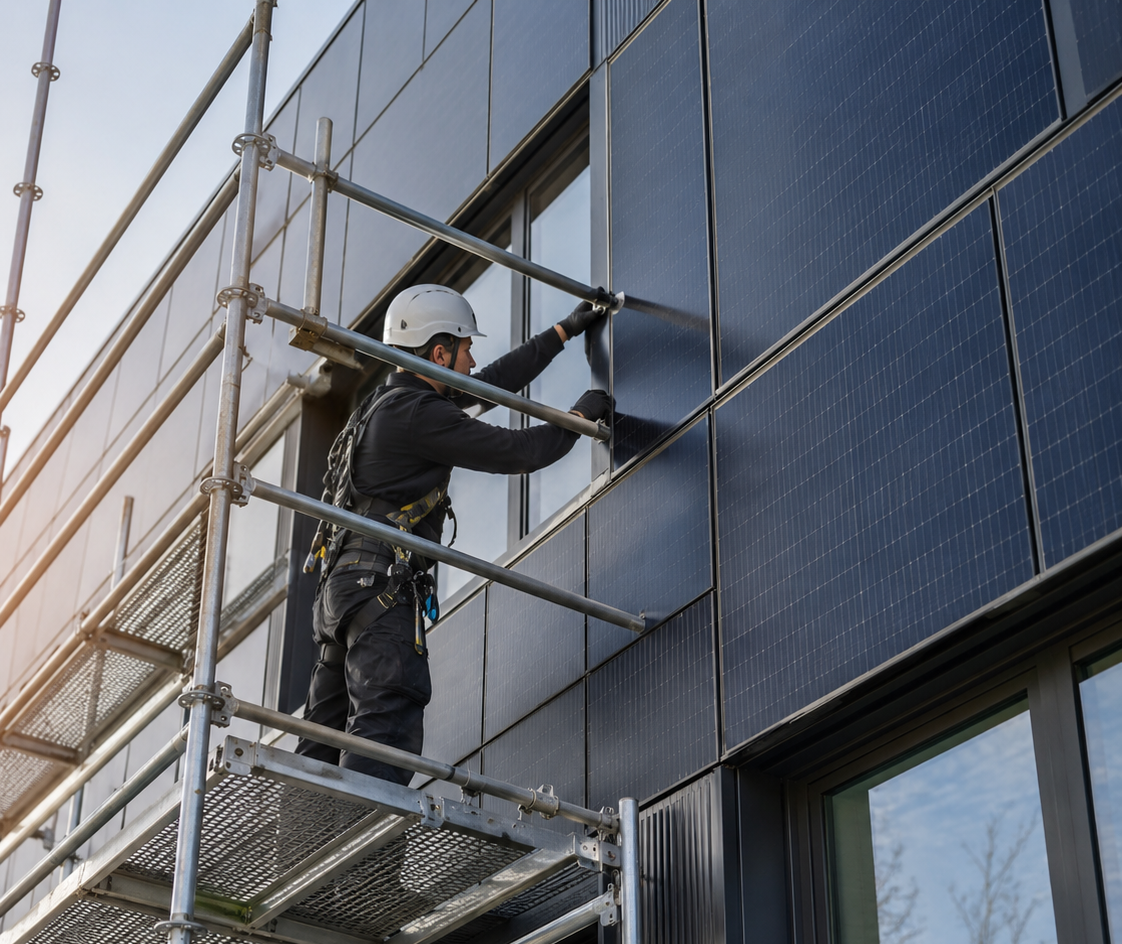
Across Europe, the first and second generations of building-integrated photovoltaic (BIPV) systems are now reaching ages where maintenance, refurbishment and component replacement are becoming unavoidable operational questions. At the same time, European policy discussions around circularity and resource efficiency are spotlighting long-term system serviceability. Within several ongoing European research projects, including SPHINX and EVERPV, investigations are underway to better understand the technical, economic and regulatory barriers that currently limit repair and recycling pathways for building-integrated photovoltaics.
In Europe, BIPV using building-integrated PV products such as tiles, shingles, and ventilated facades has been a small but steadily growing segment of the PV market since the early 2000’s. Even if the basic category of products has not fundamentally widened over the past 20 years there have been considerable improvements in technical features and performance, ease of integration and market uptake. First-generation systems with roof mounted BIPV products are approaching the end of their theoretical design life of 20 or 30 years, and larger volumes will enter phases that require curative maintenance in the coming years. Whilst maintenance requirements are more likely to originate from components other than the module or laminate itself, such as cables, junction boxes, and watertightness, the combination of form-factor constraints and specialised support and integration structures means that repair is a distinct challenge.
European standards such as EN 50583 and IEC 63092 explicitly frame BIPV modules as construction products subject to both PV and construction-product requirements, including mechanical resistance, fire safety, watertightness and durability. BIPV systems act as roofs, façades, skylights, shading devices or curtain walls while also generating electricity. This dual functionality changes maintenance logic because a failed BIPV module can trigger a building intervention rather than a simple electrical repair.
A building-applied rooftop module can generally be swapped relatively quickly if a compatible replacement module can still be sourced because conventional rooftop PV has followed the same module technology evolution than the utility-scale and commercial and industria (C&I) PV market, with the main difference being the use of modular racking integration systems. BIPV, however, has simultaneously evolved in a different direction, with a slower PV cell technology adaptation, and bespoke products developed to meet the requirements of a broad range of architectural designs and building typologies, especially in façade applications.
Building long-term compatibility into BIPV products
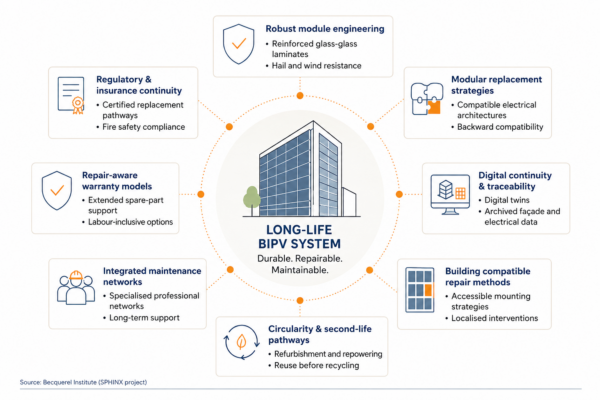
The central challenge is compatibility. Repairability in of systems using BIPV products is strongly constrained by what can be described as “form-factor lock-in”. Many BIPV products are designed around specific architectural requirements including dimensions, transparency, colour, mounting interfaces, glazing composition and electrical configuration. Once installed, these systems may require near-identical replacement products decades later to maintain both building compliance and aesthetic continuity. European technical approval systems already reflect this issue. In France, for example, ATEC technical approvals are delivered for a very specific combination of module, mounting system, dimensions and implementation conditions, meaning that even moderate design changes can invalidate the original approved configuration, potentially affecting building insurability.
Analysis indicates that warranties from European module and BIPV product manufacturers generally reserve the right to replace failed modules with “equivalent products available at the time of claim”, rather than identical products, implicitly acknowledging that exact continuity cannot be guaranteed over long building lifetimes. For many ageing BIPV systems, the problem is not whether a module still works, but whether a compatible replacement still exists.
How can repair become economically viable?
France installed roughly 300 000 systems using BIPV products, mostly in-roof mounting systems, between 2006 and 2014. A survey of French PV maintainers and repair professionals suggests that the main barriers to repairing systems integrated into buildings are often economic and contractual rather than purely technical. Economic and insurance-related concerns appeared among the most recurrent themes in maintainer responses. Respondents repeatedly cited the high cost of partial repair compared with full repowering, particularly where scaffolding, diagnostics, rewiring and façade intervention are required.
Insurance and warranty continuity also emerged as major concerns. Several maintainers indicated that replacing isolated components can create uncertainty regarding the ten-year mandatory watertightness liability insurance (décennale) on roofs, ATEC system conformity and building insurance coverage after intervention. Others noted that older systems frequently suffer from component obsolescence, making it difficult to source electrically and mechanically compatible replacement modules without redesigning larger parts of the installation.
The survey also highlights barriers that are more specific to systems using integrated PV products, such as in-roof systems, falling under the French definition of BIPV. Multiple respondents reported that building owners often lose confidence in the system’s ability to maintain its building-envelope function after a defect appears, particularly in cases involving water ingress on integrated roofing systems. Waterproofing failures, ageing integration kits and uncertainty regarding long-term performance were repeatedly associated with decisions to replace entire systems rather than repair isolated components.
Maintainers additionally pointed to the absence of structured refurbishment channels and limited availability of replacement components, suggesting that the broader repair ecosystem for BIPV remains underdeveloped. Interestingly, professionals that indicated repairing systems more frequently were also those with more extensive professional PV networks. Together, these findings suggest that improving long-term BIPV repairability will require not only more durable products, but also better compatibility strategies, stronger maintenance networks and clearer insurance and warranty frameworks.
Rethinking warranties and repair pathways
Whilst system owners ultimately decide whether to repair, replace or decommission a failed installation, manufacturers and installers strongly shape the available options. A review of warranty conditions for BIPV products commercialised in southern Europe shows that manufacturers generally retain control over the remedy applied to defective products, deciding whether systems are repaired, replaced or financially compensated. In many cases, warranties cover only the replacement component itself, while excluding or only partially covering labour, transport, access equipment, dismantling or waterproofing restoration. This distinction is critical because, in BIPV, intervention costs are often driven far more by site logistics than by the value of the module itself.
For systems integrated into buildings, replacing the module is sometimes the easiest part of the repair. Replacing a façade- or roof-integrated module can require scaffolding, temporary weather protection, dismantling surrounding building elements, specialised glazing operations and electrical safety procedures to maintain compliance with insurance, safety and building-performance requirements. In some contexts, particularly in France, remuneration schemes linked to BIPV feed-in tariffs restrict the extent to which systems can be modified while retaining tariff eligibility. If compatible replacement products are unavailable, producers may therefore face very limited repair options.
Preliminary techno-economic analyses undertaken in the Horizon Europe SPHINX project indicate that intervention costs of several thousand euros are common even for relatively small systems, particularly where accessibility is difficult. However, robust comparative data on real-world BIPV repair, access and intervention costs remain extremely limited across Europe, particularly for ageing integrated systems.
Current research activities are therefore seeking to better document how labour, access constraints, insurance requirements cost influence repair decisions in practice. Under these conditions, repair rapidly becomes an economic rather than technical question.
Several maintainers interviewed within SPHINX project indicated that scaffolding and waterproofing interventions alone can exceed the residual economic value of continued electricity production for ageing small roof-integrated systems. Where no immediate safety or building-function issues exist, decommissioning or full repowering may therefore become financially more attractive than partial repair.
In practice, the key issue is rarely whether repair is technically possible, but whether any actor is willing to assume the operational, financial and insurance risks associated with carrying it out. Current warranty structures and maintenance practices often prioritise rapid restoration of production and contractual clarity over component-level repair.
Preserving compatibility through digital continuity
Because compatibility over several decades may become one of the main repairability barriers, manufacturers are increasingly exploring digital continuity strategies. For architecturally unique systems, digital archives can preserve dimensions, glazing composition, colour rendering, transparency levels, mounting interfaces and electrical characteristics, allowing replacement products to be reproduced even after the original production line has disappeared. This approach directly addresses one of the main repairability barriers identified in BIPV: the impossibility of sourcing visually and electrically compatible replacements years after installation.
New module architectures for maintainable BIPV products
Innovative module architectures such as matrix shingling may also improve long-term maintainability by reducing dependence on fixed electrical formats. Conventional PV modules and laminates are highly constrained by voltage and current compatibility requirements, making replacement difficult when older cell technologies disappear from the market. Matrix-based shingled architectures introduce greater flexibility in electrical configuration, potentially allowing replacement laminates to reproduce legacy electrical characteristics using newer cells and manufacturing technologies. Such adaptability could help maintain compatibility with existing inverters and strings while avoiding complete system replacement.
Long lifetimes matter
Many first-generation BIPV systems remain structurally functional even when their electrical performance declines or isolated failures occur. Yet without economically viable repair pathways, otherwise serviceable systems risk premature decommissioning and replacement. Repair and reuse may ultimately become just as important as recycling. However, second-life reuse pathways for BIPV remain limited by certification constraints, insurance requirements, the absence of standardised testing procedures for reused modules and the difficulty of guaranteeing long-term building-envelope compliance after reintegration into buildings.
In this context, future European BIPV products may need to be designed not only for efficiency and aesthetics, but also for maintainability, traceability and compatibility with long building life cycles.
The questions surrounding repairability are still emerging, and many of the operational practices, insurance frameworks and refurbishment pathways that may ultimately support long-life integrated PV systems remain under development. Across Europe, manufacturers, maintainers, insurers, researchers and building professionals are beginning to explore how future BIPV systems can better integrate maintainability, digital traceability and long-term service strategies from the design phase onward.
As part of this ongoing work, the Becquerel Institute and project partners are continuing to collect field feedback and operational data from manufacturers, installers and maintenance professionals in order to better quantify repair practices, intervention costs and long-term maintenance pathways for BIPV systems.
These topics will also be discussed during the upcoming EU co-financed SPHINX/FORESI workshop on BIPV repairability and circularity taking place on 16 June in Lyon, France.
Free registration: more information
Authors: Mélodie de l’Epine, Research & Innovation projects, Becquerel Institute & Jose Ma Vega de Seoane, Managing Director, Becquerel Institute España.
Funded by the European Union under Horizon Europe, Grant Agreement No. 101136094 — SPHINX and No. 101122208 – EVERPV. Views and opinions expressed are however those of the author(s) only and do not necessarily reflect those of the European Union or CINEA. Neither the European Union nor the granting authority can be held responsible for them.
Becquerel Institute is a strategic consulting company and applied research institute specialising in solar photovoltaics and energy transition. Founded in Brussels in 2014, with regional offices in France, Italy, and Spain, the company provides strategic advice to companies, public authorities and international organisations, across all segments of the PV value chain. Becquerel Institute is a recognised partner in European and international research programmes.
The views and opinions expressed in this article are the author’s own, and do not necessarily reflect those held by pv magazine.
This content is protected by copyright and may not be reused. If you want to cooperate with us and would like to reuse some of our content, please contact: [email protected].
Please login to comment