





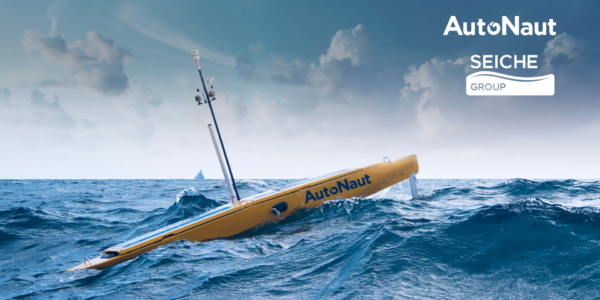
Autonaut, an uncrewed surface vehicle (USV) manufacturer and a unit of marine technology company Seiche, both based in the UK, has developed a range of vessels capable of uninterrupted data collecting at sea for several months at a time.
The compact self-propelled drones use vehicle-integrated PV (VIPV) to power the electronics and on-board battery, with forward propulsion enabled by foils.
“The solar panels directly power onboard electronics and sensors, while also charging batteries to ensure continuous operation day and night, even in challenging offshore environments,” Drew Watney, Autonaut business development and sales executive, told pv magazine.
This type of seafaring USV is another emerging marine PV application beyond boats, yachts, and buoys.
Advances in solar module efficiency and lightweight integration have benefitted the company’s product development, according to Watney.
“Higher wattage in smaller footprints allows us to support more sensors, communications, and surveillance systems without increasing size or weight. Paired with improved battery technologies, these solar innovations extend mission duration and resilience,” he explained.
The larger model is 5.0 m in length with a 440 W solar array, and the smaller is 3.75 m in length with a 175 W array. The payload capacity is 130 kg and 40kg, respectively.
Each is equipped with foils to convert wave motion into forward propulsion at a speed of 1 to 3 knots.
The USVs are made to carry a wide range of atmospheric and oceanographic sensors and passive acoustic monitoring (PAM) equipment. To improve real-time video monitoring and more reliable data communications, the company recently added Starlink satellite communications and high-definition cameras.
Autonaut vessels have recently been deployed in Norwegian waters for ecosystem monitoring, in the Barbados Exclusive Economic Zone to monitor sea-state conditions, including tropical cyclone activity, and on the UK continental shelf break, covering more than 4,000 nautical miles on a 115-day mission.
Founded in 2013, early adoption was driven by research institutions, according to Watney. There is a shift underway with “strong interest” stemming from energy companies, defence, and climate monitoring initiatives.
“The shift reflects the growing recognition that autonomous, wave-propelled platforms deliver critical data at a fraction of the cost and carbon footprint of traditional vessels,” he said.
This content is protected by copyright and may not be reused. If you want to cooperate with us and would like to reuse some of our content, please contact: editors@pv-magazine.com.


By submitting this form you agree to pv magazine using your data for the purposes of publishing your comment.
Your personal data will only be disclosed or otherwise transmitted to third parties for the purposes of spam filtering or if this is necessary for technical maintenance of the website. Any other transfer to third parties will not take place unless this is justified on the basis of applicable data protection regulations or if pv magazine is legally obliged to do so.
You may revoke this consent at any time with effect for the future, in which case your personal data will be deleted immediately. Otherwise, your data will be deleted if pv magazine has processed your request or the purpose of data storage is fulfilled.
Further information on data privacy can be found in our Data Protection Policy.