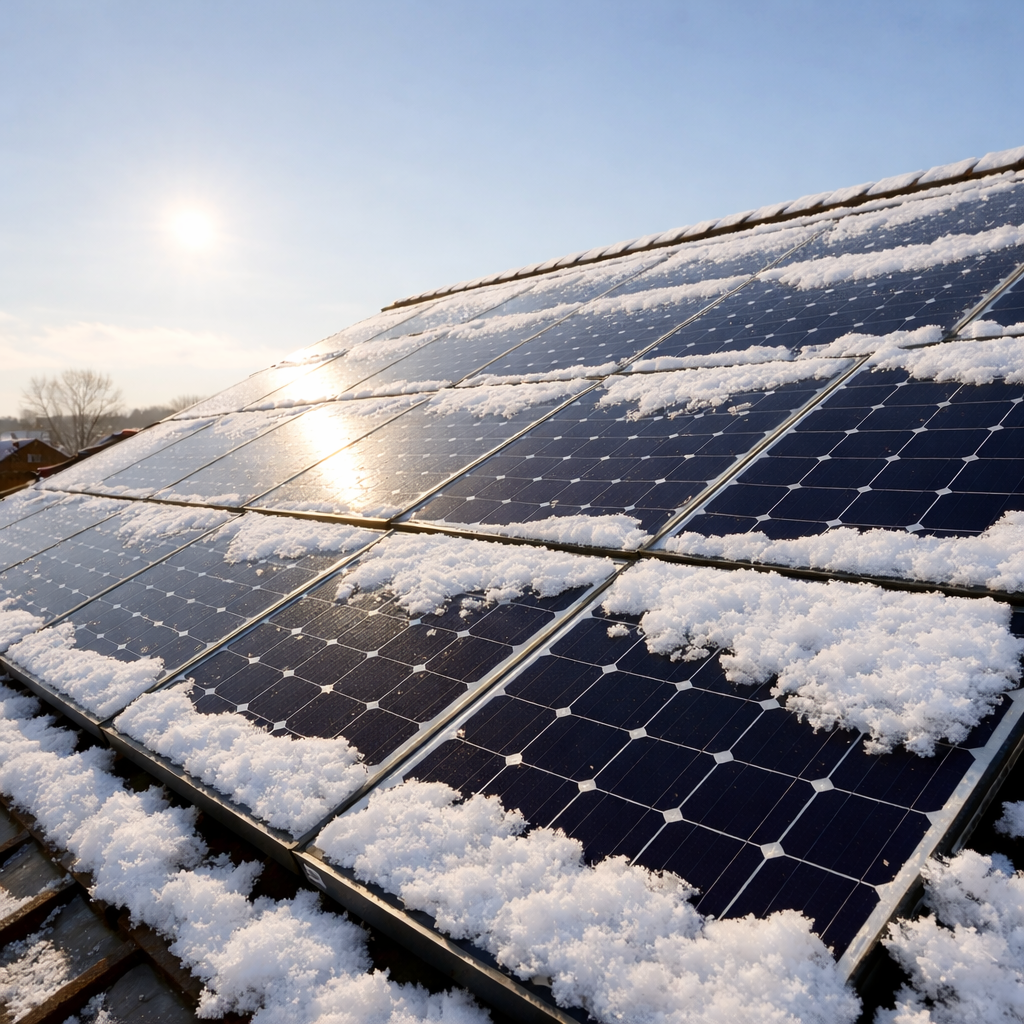





A research team led by Becquerel Sweden has developed a generalizable snow loss model to estimate snow-induced PV power losses on an hourly basis. It relies on PV system data derived solely from remote sensing sources, such as aerial imagery, light detection and ranging (LIDAR), and satellite-derived irradiance and weather data.
“We observed that our deterministic physical PV power simulation model produced systematic errors during winter months, which motivated us to improve its accuracy. Through detailed analysis, we identified snow accumulation on PV modules as a key contributing factor to these discrepancies. This led us to develop and integrate a dedicated snow loss model into our simulation framework,” Johan Lindahl, the research's corresponding author, told pv magazine.
The power simulation tool was built using a modified version of the Marion snow loss model adapted for remote sensing applications. It was optimized using data from sixteen PV reference systems that included both flat and tilted systems, and validated on an additional nine, all located in Sweden.
The researchers found that the snow loss model accuracy matches that of previous modified Marion model adaptations, while relying solely on remotely sensed inputs. It showed consistent improvements in the coefficient of determination, mean absolute error, and root mean squared error. The results were on par with previous snow loss studies.
The new snow loss model was subsequently integrated into the Swedish Alfrödull remote sensing and PV power simulation pipeline. “When incorporated into a full remote sensing-based PV power simulation pipeline, the resulting average percentage root mean square error was 5.7 % when simulating the hourly power output across 40 systems,” according to the research.
“The results validated our hypothesis, incorporating the snow loss model significantly improved our overall model accuracy, particularly in predicting power output during snow-affected periods,” said Lindahl.
The researchers concluded that individual PV power generation from multiple distributed PV systems can be assessed at scale in cold climates, even without access to system-specific technical data. It can provide accurate snow loss assessment in locations where ground-based monitoring infrastructure is limited or unavailable.
“This makes it a particularly valuable operational monitoring across large solar portfolios,” said Lindahl.
The work is detailed in “Remote sensing compatible snow loss modelling for PV power simulations,“ published in Solar Energy. The researchers involved in the study were from RISE Research Institutes of Sweden and Uppsala University.
The new model benefited from an earlier study that determined how to use LIDAR for more accurate solar panel orientation modelling.
The next step for the research group is to use the tool to identify and simulate the PV power of all PV systems within Sweden’s four low-voltage grids to use the results to “quantify the reduction in peak aggregated power generation caused by diverse system orientation,” according to Lindahl.
This content is protected by copyright and may not be reused. If you want to cooperate with us and would like to reuse some of our content, please contact: editors@pv-magazine.com.

By submitting this form you agree to pv magazine using your data for the purposes of publishing your comment.
Your personal data will only be disclosed or otherwise transmitted to third parties for the purposes of spam filtering or if this is necessary for technical maintenance of the website. Any other transfer to third parties will not take place unless this is justified on the basis of applicable data protection regulations or if pv magazine is legally obliged to do so.
You may revoke this consent at any time with effect for the future, in which case your personal data will be deleted immediately. Otherwise, your data will be deleted if pv magazine has processed your request or the purpose of data storage is fulfilled.
Further information on data privacy can be found in our Data Protection Policy.