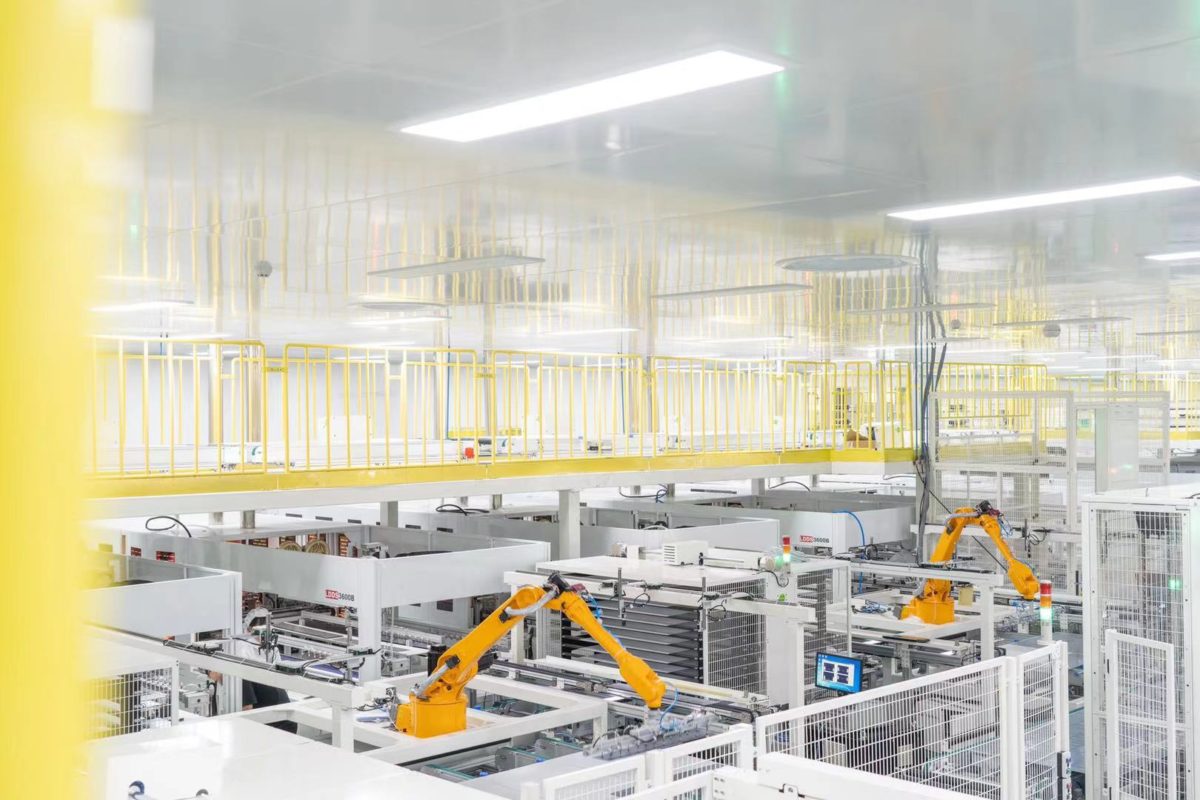





A regional government authority in Chuzhou, in China’s Anhui province, has notified Chinese module maker Eging PV of a hearing that could lead to the termination of its flagship expansion project, following prolonged shutdowns and stalled construction plans.
In a filing dated Dec. 28, 2025, Eging PV said it has received a hearing notice from the Quanjiao Economic Development Zone Administrative Committee covering the company and its subsidiaries Changzhou Eging and Chuzhou Eging. It said the authority is considering measures including terminating the original investment agreement and supplemental agreement, recovering CNY 140 million ($20.01 million) in government capital already injected, suspending a further CNY 700 million capital commitment, and pursuing claims related to construction-on-behalf costs, rent and capital-occupation fees.
Eging PV said it has applied for a hearing and noted that the outcome remains uncertain.
The project at the center of the dispute is a CNY 10.3 billion manufacturing complex announced during the solar industry’s 2022 expansion cycle. The site was designed to support 10 GW each of wafer, solar cell and PV module capacity, with an initial phase focused on 10 GW of n-type tunnel oxide passivated contact (TOPCon) solar cells.
According to the company, construction of the complex began in November 2022 and ramp-up started in July 2023. However, only 7.5 GW of the cell capacity has been completed. Wafer and module production lines were never even built.
Eging PV said the facility entered progressive shutdowns from October 2024, mainly due to weak market conditions and sharply reduced industry utilization rates.
The standoff underscores rising tension between local industrial policy expectations and the liquidity pressures facing second-tier Chinese solar manufacturers after two years of oversupply-driven price erosion. But Eging PV’s difficulties have also been compounded by governance instability. Following a court auction of shares held by former controlling shareholder Weizhi Energy, the company disclosed that it no longer has a controlling shareholder or de facto controller, leaving ownership fragmented.
Financial stress has intensified, too. Eging PV’s 2024 annual report, for example, showed revenue falling to CNY 3.48 billion, with a net loss of CNY 2.09 billion, driven by steep module price declines and underutilized capacity.
If the Quanjiao Economic Development Zone Administrative Committee proceeds with terminating the investment agreement, the immediate financial impact will depend on the final administrative decision and any subsequent dispute resolution. More broadly, the case would mark another high-profile unwinding of local government-backed solar manufacturing projects launched during China’s recent capacity expansion wave, as weaker players prioritize cash preservation over scale.
Eging PV was founded in 1998 and is one of China’s earliest PV manufacturers. It was also the country’s first A-share listed solar module company, having listed on the Shanghai Stock Exchange in 2011.
This content is protected by copyright and may not be reused. If you want to cooperate with us and would like to reuse some of our content, please contact: editors@pv-magazine.com.

By submitting this form you agree to pv magazine using your data for the purposes of publishing your comment.
Your personal data will only be disclosed or otherwise transmitted to third parties for the purposes of spam filtering or if this is necessary for technical maintenance of the website. Any other transfer to third parties will not take place unless this is justified on the basis of applicable data protection regulations or if pv magazine is legally obliged to do so.
You may revoke this consent at any time with effect for the future, in which case your personal data will be deleted immediately. Otherwise, your data will be deleted if pv magazine has processed your request or the purpose of data storage is fulfilled.
Further information on data privacy can be found in our Data Protection Policy.