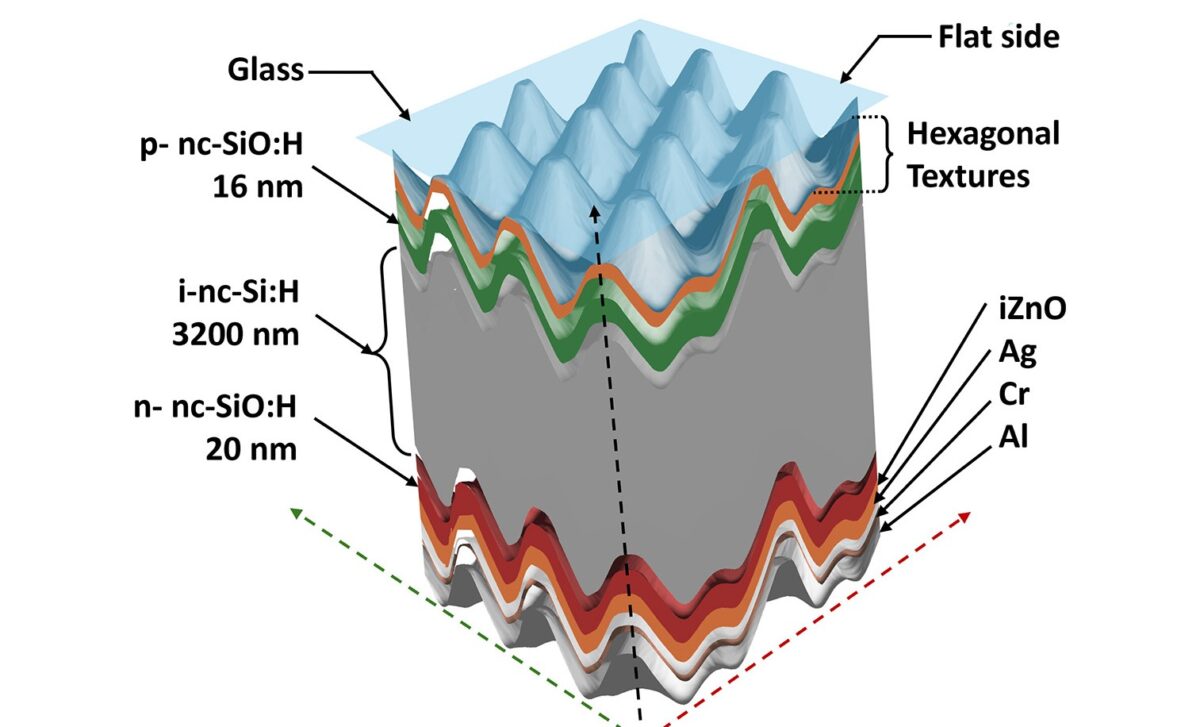





Researchers at Delft University of Technology have investigated the application and properties of a novel hexagonal glass texturing process in a superstrate configuration for thin film silicon solar devices.
“Our study has demonstrated light scattering as high as 50% even at near infra red wavelengths with honeycomb textures on glass. These high performing glass structures can benefit thin film multijunction cells,” Govind Padmakumar, corresponding author of the research, told pv magazine.
Referring to commercial modules with a glass superstrate and p-i-n device architecture, Padmakumar noted that the novel texturing enables light diffraction channels in transmission mode, enhancing the optical performance of the solar cell.
The researchers also emphasized that, when used with hydrogenated nanocrystalline silicon (nc-Si:H) technology, it can facilitate conformal, crack-free growth of silicon crystals on glass, and that deeper craters enhanced broad-angle light scattering.
The team demonstrated that the use of the hexagonal texturized glass yielded a cell with a photovoltaic conversion efficiency of 9.3% and a short-circuit current of 28.6 mA/cm2. “This is one of the highest reported current measurements on a single junction nc-Si:H solar cell in a superstrate configuration without an anti-reflection-coating,” said Padmakumar.
Used in an amorphous silicon/nanocrystalline silicon superstrate tandem solar cell, it resulted in an efficiency of 12.3%.
The researchers foresee use of the technology in solar cells for consumer electronics, solar-powered sensors, and off-grid low-power applications. “With novelty in application and results in the scientific study presented, this study will have a positive impact on solar cell performance studies including multijunction solar cells in the future,” said Padmakumar.
The group is currently working with Dutch flexible module manufacturer Lift PV (formerly HyET Solar Netherlands) in extending the use of hexagonal textures on alternative substrates and multijunction approaches to improve the performance of metal foils for use in flexible silicon and perovskite tandem devices.
The study describing the testing and application of the honeycomb-shaped micro-structures on glass technology is detailed in “Hexagonal microtextured glass to achieve high optical performance in thin-film silicon solar cells,” published in Solar Energy.
In an earlier paper, “Engineering of Hexagonal Microtextures on Glass,” published by ACS Applied Optical Materials, the same TU Delft Photovoltaic Materials and Devices (PVMD) team reported the photolithography and wet etching processes, including detailed optimizations, involved in developing the hexagonal texturing on glass.
This content is protected by copyright and may not be reused. If you want to cooperate with us and would like to reuse some of our content, please contact: editors@pv-magazine.com.


By submitting this form you agree to pv magazine using your data for the purposes of publishing your comment.
Your personal data will only be disclosed or otherwise transmitted to third parties for the purposes of spam filtering or if this is necessary for technical maintenance of the website. Any other transfer to third parties will not take place unless this is justified on the basis of applicable data protection regulations or if pv magazine is legally obliged to do so.
You may revoke this consent at any time with effect for the future, in which case your personal data will be deleted immediately. Otherwise, your data will be deleted if pv magazine has processed your request or the purpose of data storage is fulfilled.
Further information on data privacy can be found in our Data Protection Policy.