
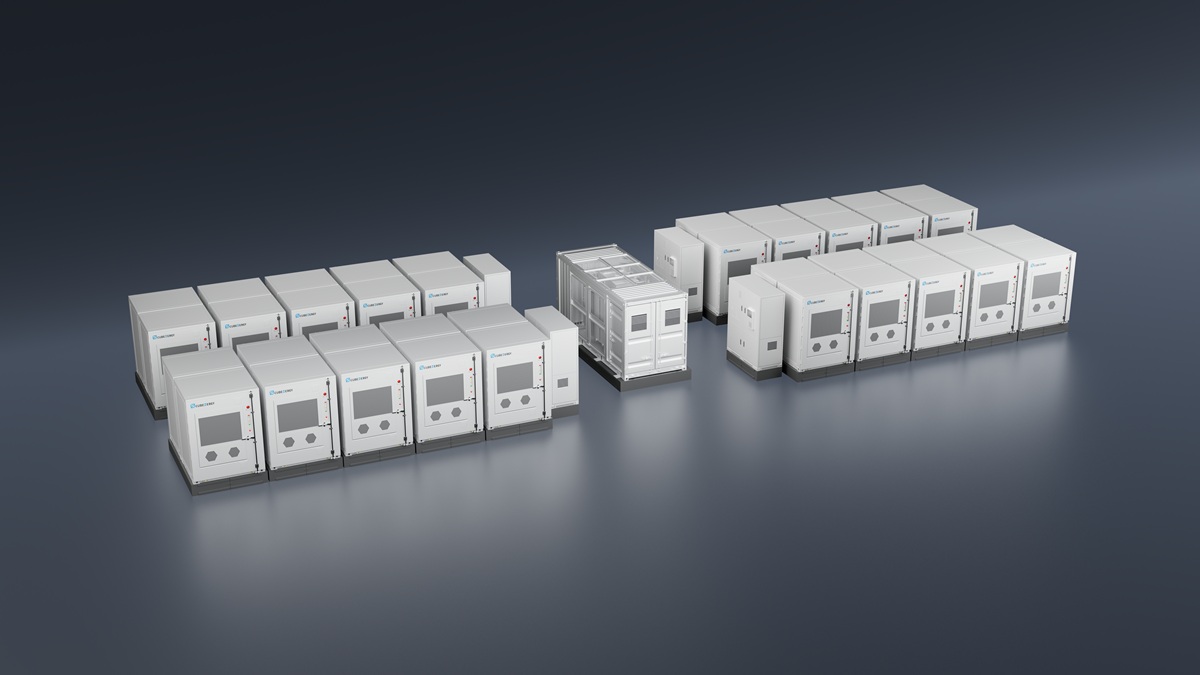





Cubenergy has launched a new solution designed for energy storage projects in Europe, which typically involve long development timelines, complex permitting procedures, and evolving grid code requirements. The company’s FlexCombo 2.0 AC Block adopts an AC/DC all-in-one design, integrating batteries, battery management systems (BMS), power conversion systems (PCS), and fire protection into standardized cabinets.
The system supports 2-hour and 4-hour configurations and can be expanded to 8 MW/16 MWh. According to Cubenergy, this approach enables project developers and asset owners to optimize initial investment while retaining flexibility for future capacity expansion.
Standardized interfaces and reserved space for expansion allow capacity upgrades without major redesign, aligning with European project financing and phased investment models. The flexibility enables expansion on demand, so that projects can reduce upfront CAPEX, scaling as they grow and investing as needed.
Grid-forming capability aligned with global grid codes
The FlexCombo 2.0 AC Block features Cubenergy’s proven Grid-Forming (GFM) technology. It supports functions such as inertia provision, continuous high- and low-voltage fault ride-through, short-circuit current contribution, fast frequency response, dynamic reactive power control, and black start capability.
FlexCombo 2.0 has obtained major international certifications, including CE marking, as well as UL 9540A and IEC62933 certification. The block is designed to comply with key European and UK grid codes, including EN 50549-1/-2/-10, VDE-AR-N 4110&4120&4130, SJV2024, TF3.3.1, EI0-16, PTPiREE, and G99 with configurable parameters to meet national and regional requirements.
Each FlexCombo 2.0 energy block weighs approximately 8 tons, is compatible with standard transport equipment, and is designed to meet common road transportation constraints. Featuring PowerSkid, the system can be installed on level ground using a portable installation module, reducing the need for concrete foundations and heavy civil works. According to Cubenergy, this design simplifies installation, shortens construction schedules, and reduces on-site risks, particularly for projects located in remote or infrastructure-constrained areas.
FlexCombo 2.0 incorporates a multi-layer safety concept aimed at preventing the spread of exhaust gases, heat transfer, and thermal runaway propagation. The company says the system’s intelligent thermal management system enables operation in –30 °C ~ +50 °C environment.
FlexCombo 2.0 is positioned for applications such as renewable integration, frequency regulation, industrial decarbonization, and AI data center power systems. Cubenergy has deployed Grid-Forming energy storage systems since 2018, including projects in weak-grid regions. Since 2021, the company has delivered several hundred megawatts of grid-forming BESS worldwide.
This content is protected by copyright and may not be reused. If you want to cooperate with us and would like to reuse some of our content, please contact: editors@pv-magazine.com.

By submitting this form you agree to pv magazine using your data for the purposes of publishing your comment.
Your personal data will only be disclosed or otherwise transmitted to third parties for the purposes of spam filtering or if this is necessary for technical maintenance of the website. Any other transfer to third parties will not take place unless this is justified on the basis of applicable data protection regulations or if pv magazine is legally obliged to do so.
You may revoke this consent at any time with effect for the future, in which case your personal data will be deleted immediately. Otherwise, your data will be deleted if pv magazine has processed your request or the purpose of data storage is fulfilled.
Further information on data privacy can be found in our Data Protection Policy.