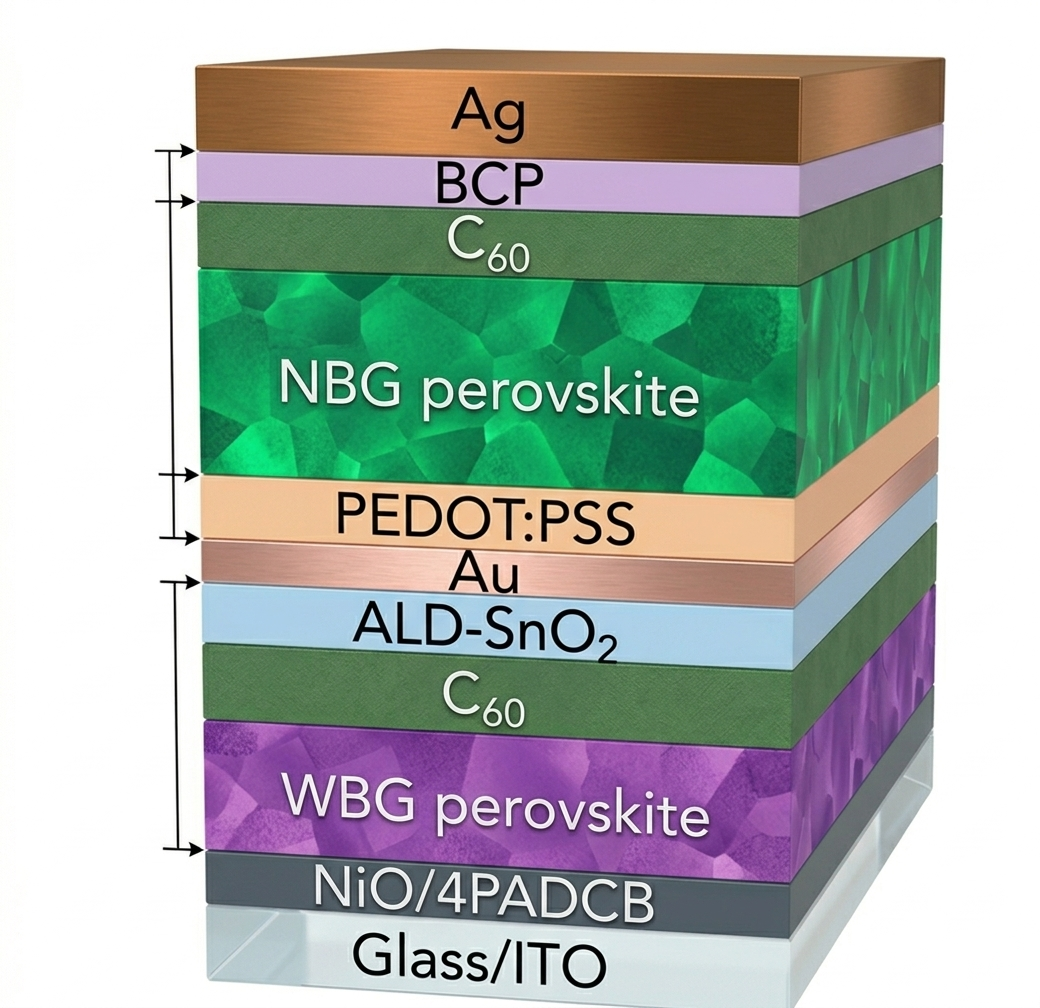





Researchers at the Huazhong University of Science and Technology in China have developed an all-perovskite tandem solar cell using a non-contact laser polishing strategy that reportedly improves the surface morphology of perovskite films and enhances device performance.
The scientists explained that, although all-perovskite tandem photovoltaic devices have achieved considerable efficiency levels, they still suffer from voltage losses and low fill factors. In the bottom narrow-bandgap (NBG) mixed tin lead (Sn-Pb) cell, these losses primarily arise from interfacial defects at the junction between the perovskite absorber and the buckminsterfullerene (C₆₀) electron transport layer (ETL).
In addition, asynchronous crystallization of tin (Sn)- and lead (Pb)-based precursors introduces structural and compositional defects, while current fabrication methods further exacerbate these issues due to slow solvent removal. High-quality perovskite films also tend to exhibit large grains with rough surfaces, leading to poor interfacial contact, increased shunting risks, and reduced carrier extraction.
Existing approaches, including solvent engineering, additive strategies, and chemical or mechanical polishing, have improved film quality but remain limited in selectivity, controllability, or scalability. To address these challenges, the research team developed a non-contact laser polishing strategy that precisely removes defective surface layers without damaging the underlying perovskite.
The academics prepared the Pb–Sn perovskite films for the bottom cell with vacuum-driven percrystallization (VDP) and found they exhibited rough, defective surfaces that hinder interfacial charge extraction at the perovskite/C₆₀ interface, leading to shunting risks and non-radiative recombination. In order to solve this issue, they used a non-contact picosecond ultraviolet laser polishing technique to improve the surface quality of films. The laser selectively removes defective and rough surface layers without damaging the underlying perovskite, reducing compositional inhomogeneity and Sn-related defects.
The newly exposed surface is subsequently reconstructed to restore a high-quality perovskite phase with improved interfacial properties. The films were spin-coated, vacuum-quenched for rapid crystallization, annealed, and subsequently surface-treated with ethane-1,2-diammonium iodide (EDAI₂). They were then deposited on the glass-ITO substrate via a controlled spin-coating and gas-assisted crystallization process. Post-treatment included p-Phenylenediaminium iodide (PDAI₂) surface passivation, followed by C₆₀, SnO₂ (ALD), and ultrathin Au interlayers.
Tested under standard illumination conditions, the bottom cell treated with the new polishing technique achieved an efficiency of 21.65%, which compares to 19.64% for a reference device. It also reached 24.07% after surface reconstruction.
The tandem solar cell was fabricated on a glass substrate coated with indium tin oxide (ITO), a NiO-based tunnel recombination junction, a self-assembled monolayer known as 4PADCB as hole transport layer (HTL), a wide-bandgap (WBG) perovskite absorber, a C₆₀/SnO₂ electron transport layer (ETL) deposited via atomic layer deposition (ALD), a gold (Au) contact, a PEDOT:PSS HTL, a narrow-bandgap (NBG) perovskite absorber, a second C₆₀ ETL, a bathocuproine (BCP) buffer layer, and a silver (Ag) metal contact.
Based on this architecture, the all-perovskite tandem solar cell achieved a champion power conversion efficiency of 29.80%, with an open-circuit voltage of 2.16 V, a short-circuit current density of 16.60 mA cm⁻², and a fill factor of 83.12%. It also delivered a steady-state efficiency of 29.18% and retained around 80% of its initial performance after 650 hours of continuous operation under 1 sun illumination.
“The proposed surface conversion strategy effectively eliminates the key surface-effect bottleneck across various perovskite compositions, paving the way for universal performance improvement,” the scientists said.
The novel cell design was presented in “Non-contact laser polishing and reconstruction towards high-efficiency all-perovskite tandem solar cells,” published in nature communications.
This content is protected by copyright and may not be reused. If you want to cooperate with us and would like to reuse some of our content, please contact: editors@pv-magazine.com.


By submitting this form you agree to pv magazine using your data for the purposes of publishing your comment.
Your personal data will only be disclosed or otherwise transmitted to third parties for the purposes of spam filtering or if this is necessary for technical maintenance of the website. Any other transfer to third parties will not take place unless this is justified on the basis of applicable data protection regulations or if pv magazine is legally obliged to do so.
You may revoke this consent at any time with effect for the future, in which case your personal data will be deleted immediately. Otherwise, your data will be deleted if pv magazine has processed your request or the purpose of data storage is fulfilled.
Further information on data privacy can be found in our Data Protection Policy.