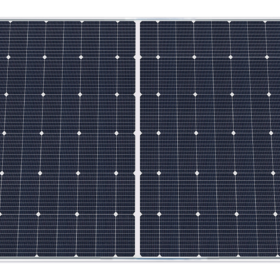
Jakson unveils 21% efficient mono PERC solar modules
The Indian solar manufacturer has announced a new Helia series of high-efficiency mono PERC PV panels, ranging from 450W to 600W outputs, and both mono-facial and bifacial categories. The multi-busbar modules apply to all installations from residential and commercial to utility-scale.
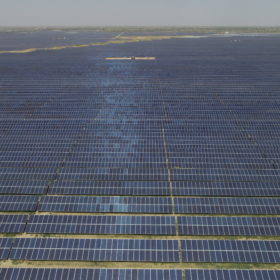
Acme Solar raises $334 million via offshore green bonds
Indian developer Acme Solar’s green bonds were oversubscribed by over three times, and will support it financing twelve projects for a combined 450MW (or 605 MWp) of its operational assets in India.
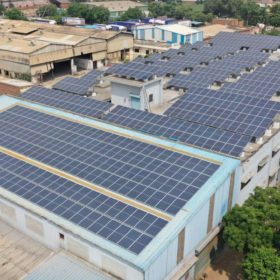
Commercial and industrial rooftops in India could deploy 1,875 MW of solar in 2021
According to a new report, India’s commercial and industrial sectors will increase their rooftop solar deployments by 47% year-on-year, with bifacials and large-size high-wattage modules offering cost-effective support for reducing electricity costs.
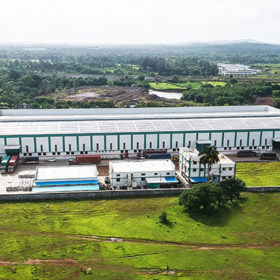
Waaree completes supply of 300+ MW solar modules for American project
The Indian-based PV module maker supplied mono PERC solar PV modules for a 250 MW project stage for a large Californian project, the 2.7GW Westlands Solar Park, located south of Fresno in California.
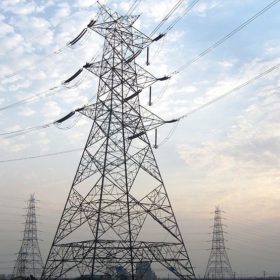
Hitachi ABB Power Grids commissions ultra-high-voltage DC link connecting Indian states
From pv magazine India. Hitachi ABB Power Grids in India today announced it has successfully commissioned one of India’s longest ultra-high voltage direct current (UHVDC) transmission links for Power Grid Corporation of India Limited. The ±800 kV, 6GW link can meet the electricity needs of more than 80 million people. It stretches 1,800-kilometers to connect […]

Vikram Solar opens 1.3 GW mono PERC module factory
Vikram Solar has reached an overall module production capacity of 2.5 GW with the opening of a 1.3 GW fab in Chennai, India. The new facility will produce mono PERC modules with peak outputs of up to 640 W.

Indian manufacturer to build 1.2 GW of mono PERC module capacity
Rayzon Solar, a Gujarat-based PV manufacturer, is scaling its production lines up to 1.5 GW with the addition of 1.2 GW of mono PERC output capacity by the end of December. The new line will produce 600 Wp panels with efficiency ratings of 21.4%.
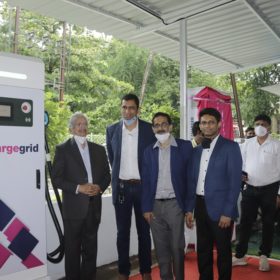
India’s largest public EV charging station
The Magenta electric vehicle charging station in Mumbai features 21 AC/DC chargers, including four DC chargers ranging from 15 kW to 50 kW of capacity and 17 AC chargers between 3.5 kW and 7.5 kW of capacity.
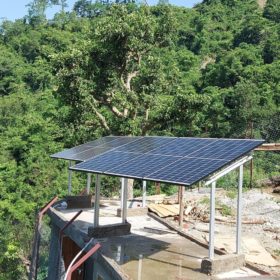
Indian ashram deploys solar+storage system
Loom Solar has installed a solar+storage system at a small ashram in the Indian state of Uttarakhand. The project features six 440 W PV modules, a 5 kWh (100 Ah/51.2 V) lithium ion storage system, and a 5 kVA string inverter.

Indian salt marsh to host 4.75 GW solar park
The Indian government aims to build a 4.75 GW solar park as part of a massive $20 billion, 30 GW hybrid renewable energy complex in Kutch, in the state of Gujarat.
