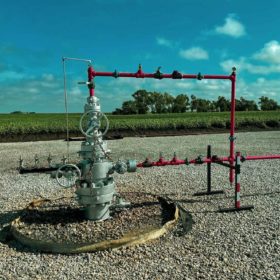
Natural hydrogen – how it works and why companies are interested
Natural hydrogen is piquing interest. Sometimes referred to as “gold” or “white” hydrogen, natural hydrogen plants offer smaller carbon footprints than sprawling green hydrogen projects, with faster development times, according to Avon McIntyre, executive director of HyTerra.
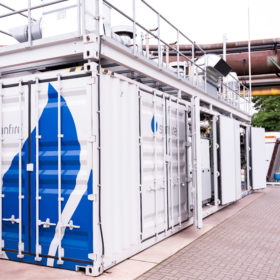
The Hydrogen Stream: Salzgitter claims record efficiency for largest high-temperature electrolyzer
Salzgitter has claimed a record efficiency level for its EU-funded GrInHy2.0 hydrogen project, which is based on solid oxide electrolysis cell tech. The high-temperature electrolyzer uses waste heat from the company’s steel production processes.
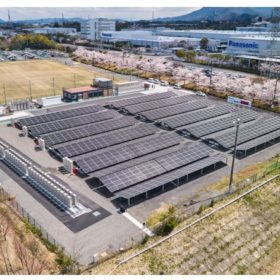
Panasonic combines fuel cells, batteries, PV to power factory in Japan
Japan’s Panasonic claims its new pilot solar-plus-hydrogen facility marks the first attempt to create a factory powered by 100% renewables, via the full-scale use of hydrogen.
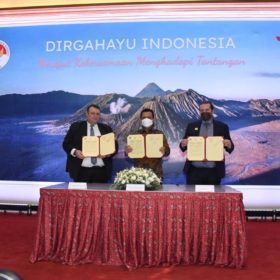
Quantum Power Asia, ib vogt propose 3.5 GW solar-storage project in Indonesia
Quantum Power Asia and ib vogt have set up a new partnership to build a 3.5 GW solar-plus-storage facility in Riau, Indonesia. The developers say the proposed $5 billion project could export solar electricity to Singapore by 2032.
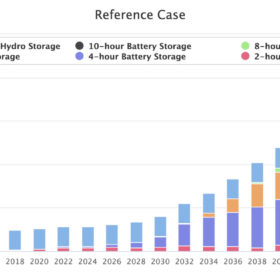
NREL’s storage projections for 2050
The National Renewable Energy Laboratory’s (NREL) final report on the future of storage presents “key learnings” from a series of six in-depth studies.
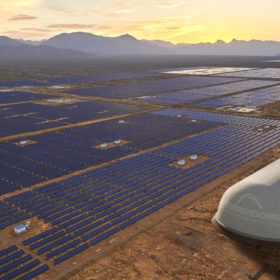
Energy Dome wins BNEF Pioneers 2022 for CO2 battery long-duration energy storage technology
Energy Dome’s emission-free energy storage method uses carbon dioxide in a closed loop charge/discharge cycle that can store and dispatch renewable energy onto the grid over periods from four to 24 hours.

To speed interconnection, consider public control of grid operators, says US law professor
To speed the interconnection of utility scale solar and storage, “maybe we want somebody running the show that has more of an interest in getting all these resources in the grid,” said law professor Shelley Welton in a webinar for “100% clean energy states.”
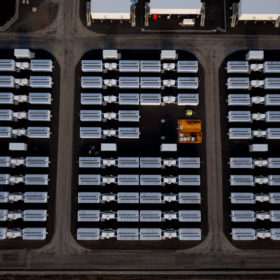
Neoen, AGL sign Australia’s first grid-scale virtual battery contract
French renewable energy developer Neoen has signed a seven-year agreement with Australian utility AGL to provide 70 MW/140 MWh of virtual battery capacity in New South Wales.
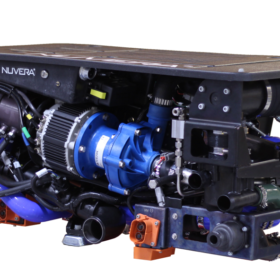
The Hydrogen Stream: Fuel cell engines for stationary power uses
In other news, Airbus and Kawasaki Heavy Industries plan to work together to prepare a hydrogen-fueled ecosystem, while Storgrundet Offshore and Lhyfe want to build a 600 MW hydrogen production plant in Sweden. Furthermore, Canada-based First Hydrogen has identified four industrial sites in the United Kingdom and is advancing discussions with landowners to secure land rights to develop green hydrogen production projects.

Hybrid thermionic-photovoltaic converter for applications in thermal energy storage, waste heat recovery
A Spanish-Italian research group has developed a solid-state thermal-to-electric energy converter based on hybrid thermionic-photovoltaics (TIPV) for different applications. It consists of a three-terminal TIPV device made with a tungsten (W) thermionic cathode, a PV/anode structure made of an indium phosphide (n-InP) anode, and a photovoltaic cell based on indium gallium arsenide (InGaAs).
