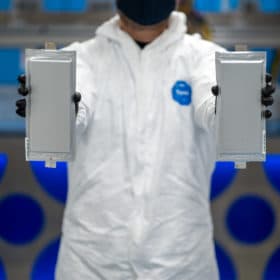
Solid-state battery maker picks up $130 million investment
US based battery company Solid Power announced that it has received $130 million in new funding from investors including Ford and BMW. With this backing, the company plans to begin pilot scale production of solid-state lithium-ion batteries suitable for electric vehicles early next year.
South African bank secures continent’s ‘first green loan’
The private-sector arm of the World Bank says it will lend up to $150 million to Johannesburg-based Absa Bank for green project funding.
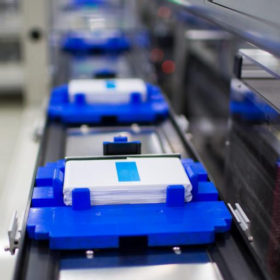
Thai plans for 8 GWh lithium battery gigafab
A Florida-based e-mobility company and a business park operator have pledged to invest up to $1 billion into the planned factory, in Chonburi province, starting with a 1 GWh section likely to take shape in 2023.

Algeria announces 1 GW renewables tender
The tender is expected to be launched between June and July and to be divided into ten lots of 100 MW each. Domestic content requirements for modules, cables and mounting structures should be included in the procurement exercise.
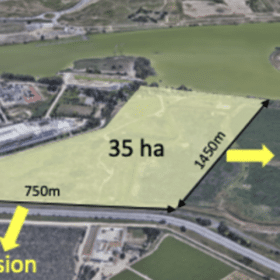
New details emerge on Spanish 5 GW solar panel factory
Greenland Gigafactory aims to start building a vertically integrated manufacturing facility in southern Spain later this year. Production activities are scheduled to start in December 2023.
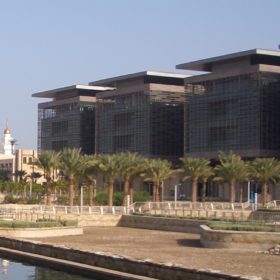
Inverted perovskite solar cell with 22.8% efficiency
The cell features an open-circuit voltage of 1.1 V and a short-circuit current of 26 milliampere per cm-2, which the research team described as the best performance for an inverted perovskite cell based on single-crystal methylammonium lead triiodide. The device was built with a microns-thick absorber layer placed between an electron transport top layer and a hole-transport bottom layer.
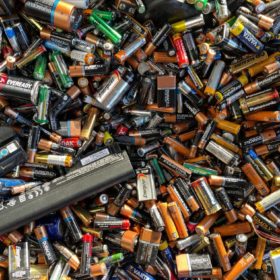
Australia’s recycling opportunity emerges as batteries boom
Australia’s national science agency has identified a potential AUD 3.1 billion ($2.4 billion) industry, as the increasing penetration of renewable energy continues to drive growth in the battery energy storage sector.

Best countries for renewable energy investment
IHS Markit has released its latest Global Renewables Markets Attractiveness Rankings, based on measures related to investment confidence and ease of development.
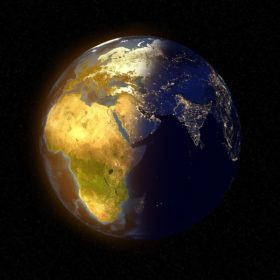
Botswana tops list of world’s ‘super abundant’ renewables nations
A Carbon Tracker report estimates 60% of the world’s technical solar potential – enough to produce 3.5 exawatt-hours of clean electricity per year – would already be cheaper than fossil fuel if installed. Of the remainder, most would be in sub-Saharan Africa, a region which has the potential to be a global solar and wind powerhouse.
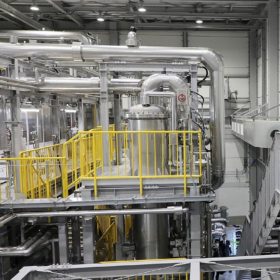
Breaking the rules to foster green hydrogen innovation
The Danish Energy Agency has granted permission, to two power-to-X specialists, for the development of innovative projects without having to comply with the country’s energy legislation. This exemption is part of an upcoming pilot scheme to support new clean energy technologies, including green hydrogen.
