
IEA urges advanced economies to support nuclear as renewables cost continues to fall
An International Energy Agency report estimates the share of nuclear power in advanced economies could fall by two-thirds by 2040, as aging plants retire. The report claims without support for nuclear, the transition to a low carbon energy system would be far more complex and threaten global emissions targets.

PV leads the way as renewables threaten coal-fired power
With clean energy being generated at lower and lower prices around the world, solar power is playing a leading role in bringing the curtain down on coal, and will help the decarbonization of transport and space heating too.

South Africa’s carbon tax could lift its PV industry
The nation appears ready to join the ranks of global solar protectionists but any fears about its energy transition may be dampened by the introduction of one of the world’s first true carbon levies – provided emitters are not afforded too many loopholes.

EDF signs for millions of modules from Canadian Solar
The 1.8 GW supply deal is the largest in Canadian Solar’s history and includes the company’s new BiHiKu high-efficiency bifacial modules.

June’s FIT expiry may bring up to 4 GW of solar online in Vietnam
Although only four PV plants with a combined capacity of 150 MW were grid connected by mid-April, the Vietnamese government expects another 88 FIT-entitled solar facilities to come online by the end of next month. By Sunday, 34 projects with a combined capacity of 2.2 GW had already arrived on top of the mid-April connections.
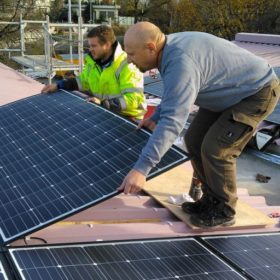
From Suntech to Sunman’s glass free modules
At the beginning of the decade, Zhengrong Shi, at that time founder and CEO of Suntech, was one of the most influential people in solar. After the Chinese module manufacturer ran into troubles in 2013, he had to go and, thus, slipped out of the spotlight. Now he is back as founder of Sunman, a company specializing in lightweight crystalline modules using polymer composite materials instead of glass. pv magazine caught up with him at Intersolar Europe 2019.
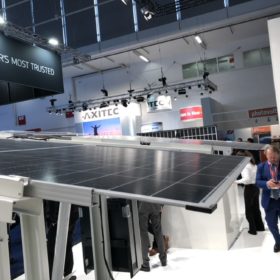
New cell efficiency records for Trina and Canadian Solar
Chinese PV manufacturer Trina Solar today announced it has achieved a new efficiency record of 24.58% for a cell based on n-type monocrystalline TOPCon technology. The record has been confirmed by the ISFH CalTeC laboratory in Germany. Meanwhile, fellow giant Canadian Solar also hit a new milestone with its cast mono technology, reaching 22.28% conversion efficiency on a 157mm² wafer.

European Parliament elections – the green wave broke far from the shore
Traditional, centrist groupings the social democrats and conservatives lost ground in the weekend’s elections but while green parties gained seats, talk of a green wave washing over the continent appears to have been exaggerated.

Protectionist measures working as Chinese export destinations shift
While the world’s biggest solar manufacturers are confident there are plenty of alternative markets for a rising volume of panel exports, the message spelled out by first-quarter shipment figures is that protectionism works.
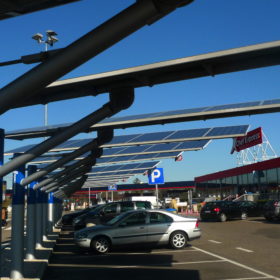
French energy agency says ‘neglected’ areas offer 53 GW of PV potential
The Ademe has identified 17,764 sites that could help France’s ambitious solar plans to materialize. Many neglected areas that are suitable for solar are old deposits of hydrocarbons, but parking lots also offer an additional 4 GW of potential.
