
Tenerife plans 350 MW of solar alongside 1 GWh storage
A new project is in line with the target of the Island Council of Tenerife to cover all electricity demand with renewable energy. The development of electromobility and storage is key to the ambition.

Development lender to help Egypt deploy 600 MW of solar in West Nile
World Bank Group member the IFC has signed an agreement to implement tendered projects with the Egyptian Electricity Transmission Company. The tender for the solar complex was launched at the end of 2017.
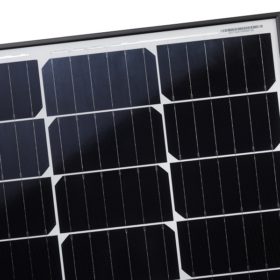
Q-Cells unveils new half-cell monocrystalline panel
According to the Korean manufacturer, its Q.Peak Duo-G6 module is produced with larger wafers than those used in the G5. This is said to increase module yield by around 6% for a power output ranging from 355-420 W.
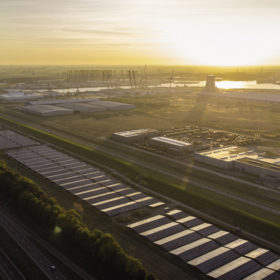
Another 3 GW on the way for the Netherlands PV market
The slew of new capacity will come from projects allocated from the bids received for the autumn 2018 round of the SDE+ program for large scale renewables. The Dutch Central Agency for Statistics revealed new PV additions last year were 200 MW more than predicted, at 1.5 GW, and the government last week announced net metering conditions for rooftop solar would be maintained until 2023.
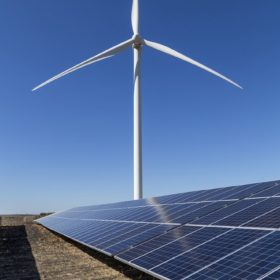
An argument for renewables, and for a new utility paradigm
In late January 2019, California’s largest investor-owned utility Pacific Gas and Electric (PG&E) declared bankruptcy for the second time, causing anxiety for investors, ratepayers, employees, PPA holders, elected government officials and, lest we forget, fire and gas explosion victims. Judge Alsup, who is overseeing PG&E’s probation from its felony conviction, lambasted the company for violating its probation. “To my mind, there’s a very clear-cut pattern here: that PG&E is starting these fires,” Alsup said. “What do we do? Does the judge just turn a blind eye and say, ‘PG&E continue your business as usual. Kill more people by starting more fires.”
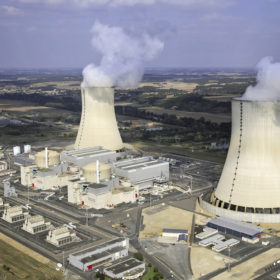
The weekend read: Playing by the carbon footprint rules
Developers and manufacturers looking to enter France’s utility-scale segment must deal with controversial rules which prioritize projects relying on low-carbon emission modules. But what makes a low-emission module? Clearly ones that are made in France or elsewhere in Europe, according to market data. But despite clearly increasing project costs, the rules do not seem to be an obstacle for the planned gigawatt-scale growth of solar in the country over the coming years.
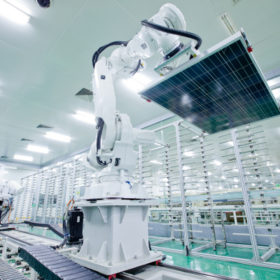
Pre-webinar interview: Bifacial PV – glass-glass or glass-backsheet?
In preparation for the next pv magazine webinar “New approach for bifacial modules and yield expectations” on Monday 29 April, 2pm – 3pm (CEST), Andrea Viaro, head of technical service Europe, JinkoSolar and Lucie Garreau-iles, technical manager, EMEA, DuPont, in the following answer the questions by pv magazine on why create an alternative to the bifacial glass-glass-modules

Ailing Singyes forced to delay annual report again
Loan defaults have brought business at the solar goods maker and EPC to a halt and a lack of progress reports on its formerly lucrative project contracts means there is no immediate prospect of seeing the company’s 2018 figures.
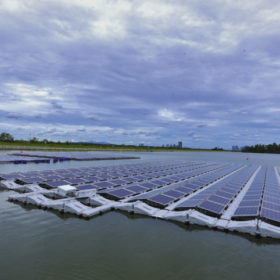
Dutch government plans 100 MW floating PV project at dredging spoil depot
Two government agencies and the Port of Rotterdam are planning to deploy the installation at De Slufter, a 250-hectare depot for contaminated sediment.
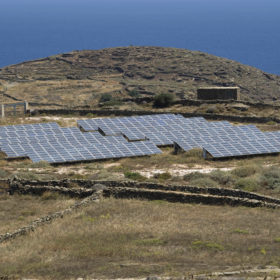
PV hits lowest tariff in Greece’s first solar-wind tender: €0.053
Solar power has broken two records. It offered the lowest tariff in Greece’s first joint PV-wind tender – a payment level that is also the lowest ever awarded a Greek PV project.
