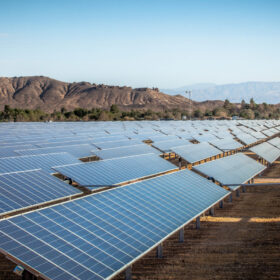
US Treasury Department releases guidance on domestic solar content
The US Inflation Reduction Act includes a 10% bonus for solar power projects that use US-made content, and the Department of the Treasury has released long-awaited details on what this means.
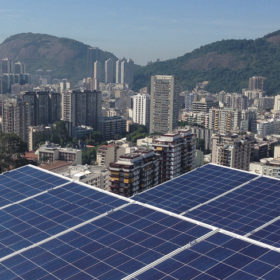
Brazil surpasses 29 GW of installed PV capacity
In terms of centralized generation, the country has more than 104.4 GW of awarded projects still under construction or in development, while in distributed generation, there was more than 30 GW as of February from projects with connection requests made by Jan. 1. In both segments, the availability of network connections remains a barrier in carrying out projects.
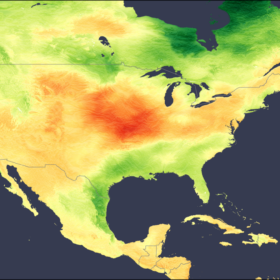
April irradiance up for US and Mexico, down for Canada
In a new weekly update for pv magazine, Solcast, a DNV company, presents the solar irradiance data it collected for North America in April. These data show that positive departures from normal April irradiation benefitted solar producers from California, Baja California and Sonora right across the continent to Pennsylvania, New Jersey and Maine.
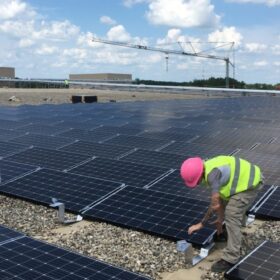
US commercial PV can meet 35% of electricity demand of manufacturers
Northeastern University researchers have looked at energy use in manufacturing sectors and have found great potential for facilities to generate a portion of their own power with on-site rooftop solar installations.
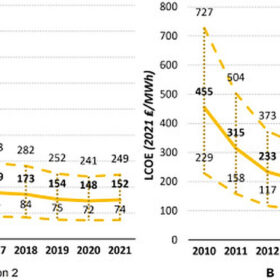
UK solar systems to be 50% cheaper by 2035, say UK researchers
University of Surrey researchers say that by 2035, the levelized cost of energy (LCOE) for small projects and utility-scale PV systems could decrease to GBP 149 ($187)/MWh and GBP 51/MWh, respectively.
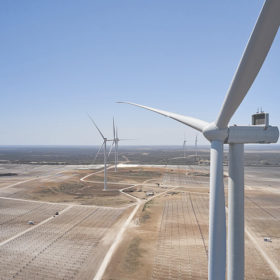
Tools to monitor PV hybrid system performance
Owners and operators of PV hybrid systems need to monitor and control system operation and performance, which generally involves the collection of big data sets. Data visualization techniques can simplify the monitoring and allow issues to be quickly recognized, says IEA-PVPS.
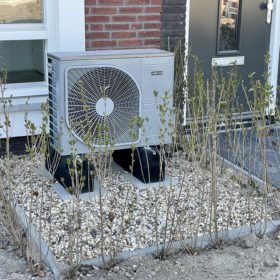
German heat pump sales grow by 111% in first quarter
Sales of gas and oil heating systems are also increasing, however, as the current figures from the Federation of German Heating Industry show. Overall, the market grew by 38% to 306,500 new heaters sold. However, the German Renewable Energy Federation warns against postponing the country’s Building Energy Act requirements to 2027.
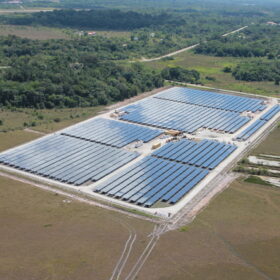
France allocates 49.8 MW in PV tender for non-interconnected areas
CRE, the French energy regulator, originally planned to allocate 83 MW in its latest procurement exercise.

Norway’s PV capacity hits 373 MW
Norway added 152.7 MW of new solar capacity in 2022 and around 70 MW in the first four months of this year.
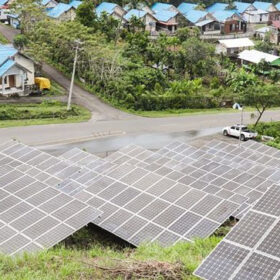
Indonesia’s race to net zero
Coal-dependent Indonesia has huge solar potential but progress toward a net zero economy has been sluggish, explain Daniel Kurniawan and Fabby Tumiwa from the Institute for Essential Services Reform (IESR), an Indonesian thinktank.
