
Malaysia launches 1 GW solar tender
Sunday will herald the largest PV procurement exercise ever held in Malaysia. Half the available capacity will be directed to 10-30 MW facilities with the balance reserved for plants with capacities of up to 50 MW.

Algeria plans 4 GW of solar tenders
The government has announced a plan to deploy new PV capacity at a mega site over the next four years. Around 800 MW of capacity is expected to be tendered annually up to 2024. To be eligible, it is anticipated all modules, cables and mounting structures must have been made in Algeria.

South Korea introduces carbon footprint rules for solar modules
The regulations will come into force on June 15 and will entail panel carbon footprints being calculated according to life cycle assessments of their environmental impacts according to the KS I ISO 14040 Korean standard.

A 17.5%-efficient dark grey solar tile
U.K. business Roof Tiles Technology Ltd has developed a solar tile with a claimed efficiency of 17.5% and power output of 175 W per square meter. The company’s founder, Antonio Lanzoni, said a PV system featuring the product would cost 25-30% more than a standard solar rooftop.
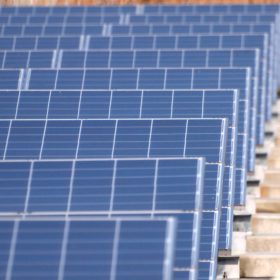
EIB greenlights €18 million loan for 65.6 MW Polish PV project
The funds will be used by Polish developer Energy Solar Projekty sp.z o.o. to build 66 PV projects selected in Poland’s auction scheme for renewable energy projects not exceeding 1 MW in size.
Dutch grid operators won’t have to compensate for deactivated solar rooftops
Minister of economic affairs and climate change, Eric Wiebes, has written to parliament to confirm grid companies do not have to pay PV system owners when their installations are disconnected from the network due to capacity issues or poor-quality voltage.
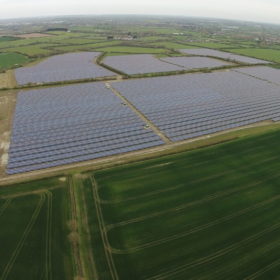
Spain and Italy are European renewables investment hot spots, says CEO, and Mexico really should be too
pv magazine spoke to Mark Jones, chief executive of privately-owned clean energy investment company Susgen about where the newly-launched business is looking to spend the cash pile it has allocated for big, early-stage project pipelines.

France embraces solar with viticulture, arboriculture and market gardening
The French government has selected seven agrivoltaic projects with a total generation capacity of 12 MW in its latest tender for innovative PV technology.

Israeli national lottery supports rooftop PV program with $0.12/kWh feed-in tariff
The incentive scheme awards a 23-year, $0.12/kWh feed-in tariff to rooftop arrays with a generation capacity of up to 200 kW. Already, 141 municipalities have applied to install 116 MW of rooftop solar capacity and the government has increased the program’s budget from $28.5 million to $143 million.

Another 500 MW of unsubsidized solar for Denmark
German PV asset manager Encavis and Danish renewables company Greengo have already secured approval for one large project.
