
Taiwan’s URE signs 120 MW glass-glass bifacial module order
United Renewable Energy has signed a memorandum of understanding to supply project developer Ye Heng Power with 120 MW of its solar panels. It plans to start shipping the PV modules in the second half.
Solar for construction
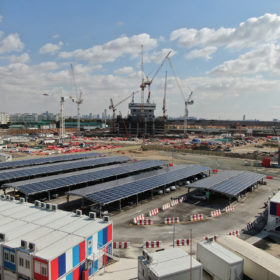
Dubai-based PV developer Enerwhere has come up with a new business model for solar projects at construction sites. Its approach, which is based on short-duration PPAs, involves moving mobile PV installations from one building site to another.

Duke Energy signs milestone power contract in North Carolina
Charlotte has become the first U.S. municipality to come to terms with Duke Energy on a solar contract through the new Green Source Advantage program.

Solar lobby group’s UK budget demands unlikely to be heeded
The UK Solar Trade Association has laid out its wish list ahead of new chancellor Rishi Sunak’s first budget speech tomorrow, with an exemption of solar from onerous tax valuations top of the agenda. COVID-19 measures, though, are likely to cast everything else into the shade.

Project developers can secure cash from new IRENA funding pot
The Climate Investment Platform launched by three multilateral bodies in September is now open for business and renewables companies in developing nations could qualify for help with clean energy facilities, renewables-related grid improvements and energy efficiency schemes.
Building on bifacial momentum
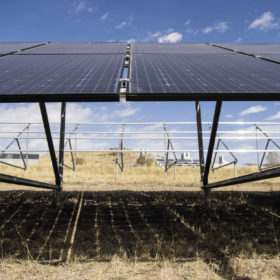
Getting the most out of a bifacial module requires a rethink at almost every level of system design and the industry is hungry for field data generated by such systems to better inform energy yield modeling and define the best approaches to maximizing yield at minimal cost. In May, the U.S. National Renewable Energy Laboratory began a three-year study into bifacial performance which is beginning to yield results.

EU climate law sets the stage for a green transformation
Although decried for lacking ambition and as an abdication of responsibility in some quarters, the climate law proposed by the European Commission may be more ambitious than it first appears, as Felicia Jackson, from the center for sustainable finance of the School of Oriental and African Studies at the University of London – considers here.

India mulls alternatives to bank guarantees for PV projects
Lobby group the National Solar Energy Federation of India has welcomed the move and asked the Ministry of New and Renewable Energy to extend any such measures to existing contracts to help developers meet working capital requirements.

Desalinating water with mobile solar-powered devices
A U.K. research team has developed a desalination mechanism that could offer a new way to provide drinking water and irrigate remote areas affected by natural disasters. Although the portable device is still in an initial, experimental phase, it can be powered by solar energy, as it has no moving parts and only requires small amounts of electricity.
Solar-powered hydrogen production in Japan
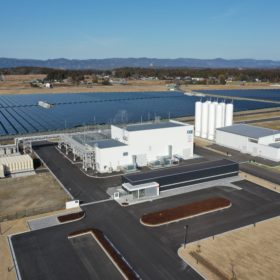
Toshiba has finalized construction of a 10 MW hydrogen plant in Fukushima prefecture which draws power from 20 MW of solar generation capacity as well as the grid.
