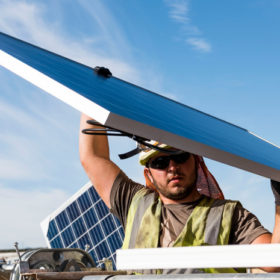
Solar PV employed around 3.4 million people in 2021
Almost half of the workers were employed in China, around 280,000 in North America, over 260,000 in Europe, and some 50,000 in Africa, according to a new report by the International Energy Agency (IEA). The vast majority of workers were employed in manufacturing and installation of new capacity, with solar jobs paying lower wage premiums than the nuclear, oil, and gas industries.
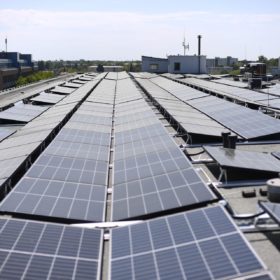
Pakistani regulator clarifies net metering proposal
A consultation about raising the level of payments made for excess household electricity injected into the grid appears to have prompted fears it could raise solar power prices across the board.
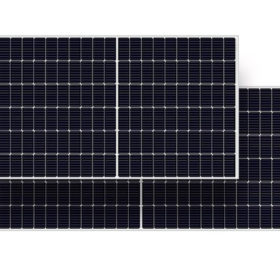
Jinergy unveils all-black solar module series for rooftop PV
The all-black series includes a monofacial PERC module with an efficiency of up to 20.86% and an n-type heterojunction product with an efficiency of 21.68%. Both products feature all-black integrated design, with black backsheet, black busbar, black frame and black encapsulant material.
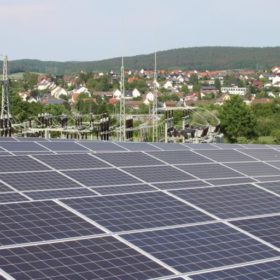
Germany introduces tax breaks for rooftop PV
The German government continues to respond to the energy crisis by implementing measures supporting small-sized PV. This time, the tax breaks are intended to support solar arrays below 30 kW in size.
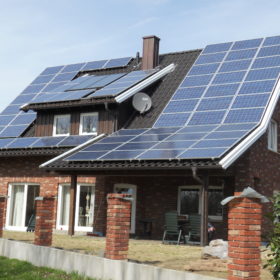
French government announces new measures to support solar self-consumption
The government announced new measures in favor of collective and individual self-consumption, validated by the Higher Energy Council on September 8.
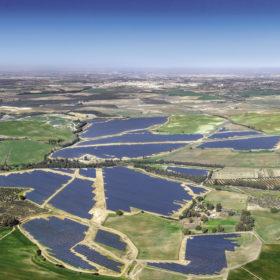
Spain set to hit 20 GW milestone
Spain has reached 17.1 GW of large-scale PV capacity and 2.5 GW of solar under the self-consumption regime, according to new figures from grid operator REE.
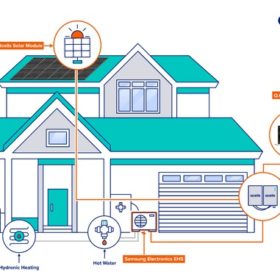
Hanwha Q Cells launches residential solar-storage-heat pump solution in Europe
Hanwha Q Cells has combined its solar panels and batteries with Samsung’s heat pumps. The offering includes an app that reportedly optimizes power consumption while maximizing solar power utilization.
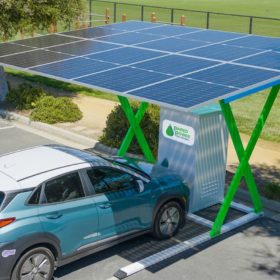
US startup unveils 5 kW solar canopy for EV charging
Paired Power said its new 5 kW solar canopy measures 3.2 meters x 5.2 meters x 3.7 meters and can host up to 10 bifacial solar panels. It can be used in on-grid or off-grid modes and can be paired with lithium-ion battery storage systems up to 40 kWh in size.

US investment giant snaps up New Zealand rooftop solar specialist
BlackRock has agreed to acquire SolarZero, a New Zealand rooftop PV specialist, as part of its push into renewable energy in the Asia-Pacific region.
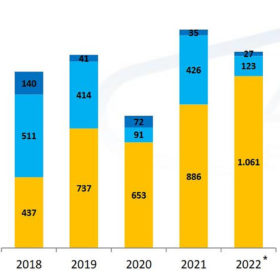
Italy deployed 1 GW of PV in H1
Italy’s cumulative PV capacity surpassed 23 GW at the end of June. Rooftop PV continues to drive the Italian solar market, but the large-scale segment is finally showing the first signs of a real recovery.
