
Spanish researchers developing rear-side concentrated PV modules for agrivoltaics
Researchers at University of Jaén in Spain have demonstrated a semi-transparent crystalline silicon solar photovoltaic module with rear-side optical concentrators for agrivoltaics applications.

European solar manufacturing ‘considerably behind’ NZIA targets, says EU observatory
A report from the Clean Energy Technology Observatory finds that while the EU is a technology leader in PV inverters, trackers and mounting structures, its manufacturing capacity in solar ingots, wafers, cells and modules falls far behind targets set by the Net Zero Industry Act.

Nexwafe secures cash injection from EU scale up funding
German solar wafer manufacturer Nexwafe is one of eight companies receiving investment in the latest round of the European Commission’s Strategic Technologies for Europe Platform (STEP) Scale Up call, an initiative addressing a market gap in deep tech funding in Europe.

Longi achieves 33.35% efficiency for flexible perovskite-silicon tandem solar cell
The Chinese manufacturer said the tandem device was developed through a dual-buffer layer strategy that improves interfacial adhesion while preserving efficient charge extraction. The efficiency result was certified by the US Department of Energy’s National Renewable Energy Laboratory (NREL)
South Korea sets 2030 goal for perovskite-silicon tandem solar panels
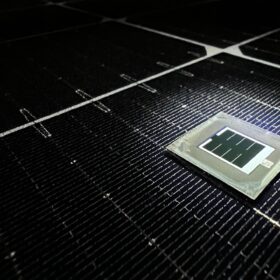
South Korea has allocated KRW 33.6 billion ($22.8 million) for R&D on perovskite-silicon tandem solar technology with a goal of commercializing 28%-efficient modules by 2030, according to the Ministry of Economy and Finance.
ChasingLight Technology launches indoor organic PV modules
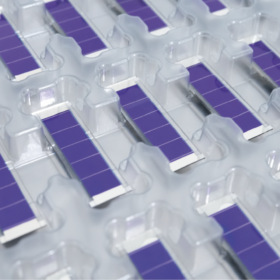
The China-based organic photovoltaics manufacturer has launched a line of indoor PV modules suitable for integration into digital office products and electronic devices.

Photonic curing could accelerate transition to copper-metallized solar cells
Researchers in the United States have developed a photonic curing technique using laser sintering to rapidly heat and cure copper pastes on temperature-sensitive solar cell substrates without causing thermal stress. The process purportedly produces dense, low-porosity copper layers with strong adhesion to indium tin oxide, achieving low bulk and contact resistivity.
China dominates global polysilicon capacity, says Bernreuter Research
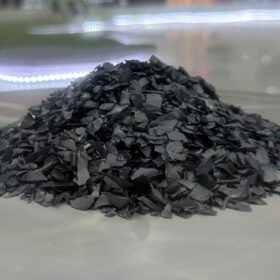
Bernreuter Research says nine of the world’s ten largest polysilicon manufacturers are based in China, with Tongwei, GCL Technology, Daqo New Energy and Xinte Energy holding a combined 65 percent share of global output in 2024.

Perovskite solar cell based on Mxene achieves record-breaking efficiency of 25.75%
A research team in Spain has built what it claims to be the world’s most efficient perovskite solar cell using MXenes or any other type of 2D-materials. The device relies on a Mxene interlayer that suppresses non-radiative recombination and improved charge extraction at the interface between the perovskite absorber and the electron transport layer.

Sharp offers space-qualified solar cells, plans perovskite-silicon tandem production
The Japanese technology company is offering three types of space-grade compound solar cell designs for satellites and spacecraft.
