
Researchers build 24.4%-efficient perovskite solar cells with room temperature process
Researchers from the U.S. and South Korea have developed a method to make high-quality perovskite films at room temperature. The film was tested in a conventional perovskite solar cell architecture and the result was a power conversion efficiency of exceeding 24%.

East-west rooftop solar ideal for energy communities under net metering
Researchers in Italy have investigated the potential of deploying energy communities based on east-west PV systems and have concluded that these projects, despite their lower energy yields compared to south-oriented installations, show higher shared energy values. They also warned, however, that the presence of a net metering scheme is crucial to make the east-west layout the preferred option.

Perovskite tandem PV integrator secures $4.7 million of US funds
The US Department of Energy (DoE) has provided Tandem PV with $4.7 million in funds to advance the commercialization of the company’s thin-film solar technology.

IEC lays ground for flexible silicon solar module standards
In its second monthly column for pv magazine, the IEC highlights the research on flexible crystalline silicon solar cells led by researcher Zhengxin Liu, the Vice Chair of IEC Technical Committee 82, which prepares standards for solar PV energy systems.

Study finds excessive row spacing has limited effect on improving PV system performance
Scientists in China have tested the influence of panel row spacing in increasing a PV system performance in a full-scale outdoor PV array experimental platform. They found that larger row spacing plays a limited role in improving thermal convection, observing that solar irradiance and wind speed are the key parameters for optimal PV system design.
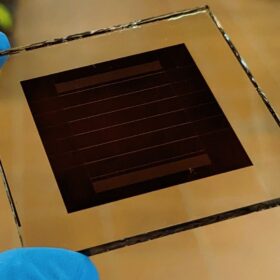
Italian startup develops 20.7%-efficient mini perovskite solar modules with 99.6% geometrical fill factor
Solertix claims to have reduced yield losses in cell-to-module scaling by utilizing ultranarrow interconnection of 19.5 μm. It also says the proposed interconnection technique may be used to achieve a 30% efficiency in area-matched 4T tandem designs featuring a perovskite module over a silicon cell.
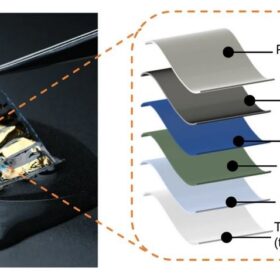
Japanese researchers build 14.3%-efficient bendable, waterproof organic solar cell
Researchers from Japan’s Riken Center for Emergent Matter Science have fabricated an organic solar cell that has achieved waterproofness without reducing flexibility. At 3 micrometers thick, it is thought to be the first cell of its kind to survive a washing machine cycle and retain efficiency after multiple cycles.
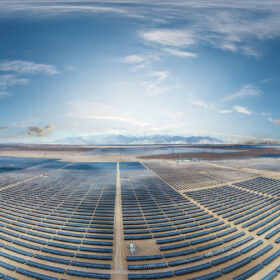
Are the days of cheap finance for Chinese solar over?
The Chinese PV industry has benefited from the availability of substantial finance over the past two decades, supporting the development of the renewable, zero-carbon capability essential for meeting the goals of the Paris climate agreement. Easy access to finance has led to unsustainably low prices and unnecessary losses, however, impacting China’s ability to sustain support for renewable energy systems. As the nation expands clean power installations and enhances grid-balancing capacity, maintaining consistent financial support has become more challenging.
TCL Zhonghuan reveals plans to acquire majority stake in Maxeon
Chinese wafer manufacturer TCL Zhonghuan says it wants to invest around $197.5 million to increase its stake in Maxeon from 22.39% to at least 50.1%. A Maxeon spokesperson told pv magazine that the plan would place the company in a solid financial position.

JinkoSolar comments on removal from BloombergNEF’s Q2 tier-1 list
JinkoSolar says its exclusion from BloombergNEF’s second-quarter list of tier-1 solar module manufacturers was due to a civil case involving a subsidiary, rather than financial issues.
