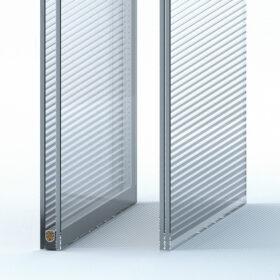
Panasonic testing BIPV glass based on perovskites
Panasonic is now testing perovskite-based power-generating glass with Japanese property developer Mitsui Fudosan Residential at a new building in Kanagawa prefecture, Japan.
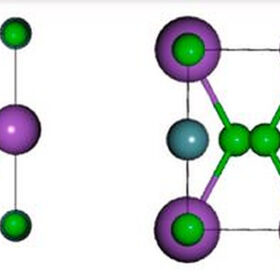
New perovskite material for lead-free solar cells
An Algerian research group has analyzed the electronic, elastic, optical, and thermoelectric characteristics of the KGeCl3 perovskite to verify if this lead-free material may be used for solar cells and other electronic devices. The scientists found that the novel material has a direct bandgap semiconductor with bandgap energies of 0.92 eV, 1.26 eV, and 1.88 eV for cubic, tetragonal, and orthorhombic phases, respectively.
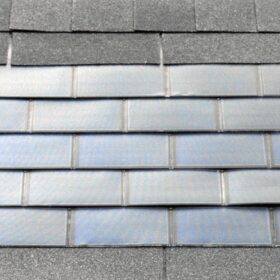
IEA-PVPS releases guide for applying innovation system approach to BIPV
IEA-PVPS has published a new handbook that provides support for Technological Innovation System (TIS) analysis for building-integrated photovoltaics (BIPV).
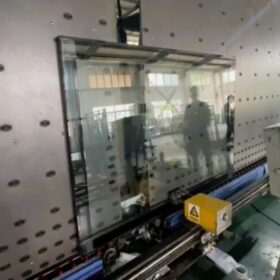
ClearVue next-gen ‘solar window’ powers through mass production run
Australia’s ClearVue Technologies says it has confirmed the scalability and “commercial viability” of its second-generation integrated glazing units, following a mass production run using a standard manufacturing line at a factory in China.
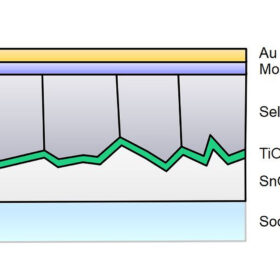
Selenium solar cell built with laser-annealing achieves record fill factor of 63.7%
Built by Danish researchers, the device also achieved a power conversion efficiency of 5.0%. They designed the cell with a soda-lime glass substrate, a tin oxide (FTO) layer, an electron transport layer made of titanium oxide (TiO2), a selenium absorber, a molybdenum oxide (MoOx) layer, and a gold (Au) metal contact.
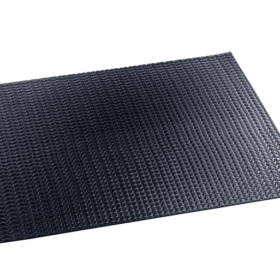
New production facility for vehicle-integrated photovoltaics in Germany
OPES Solar Mobility, a joint venture between solar module specialist OPES Solutions and a German family office, is creating manufacturing capacity with its own technology in Germany to provide specific support to the transportation industry.

New silver paste product promises TOPCon solar cell gains
China’s Solamet has launched a new silver paste product for tunnel oxide passivated contact (TOPCon) solar cells processed with laser carrier injection technology. By solving a problem related to contact between the paste and the boron doped front surface of the silicon cell, it promises an efficiency improvement of at least 0.2% over competing products.

Solar for water deionization
Scientists in Canada have combined PV power generation with water purification based on capacitive deionization (CDI), which is claimed to have low operational cost, enhanced energy efficiency, and less water rejection than conventional purification techniques. The solar-powered system prototype is able to produce more water than a conventional CDI system on a sunny day.
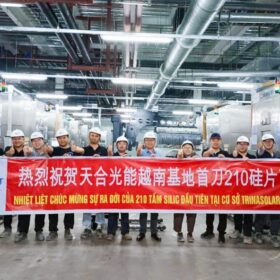
Trina Solar begins producing 210 mm wafers at 6.5 GW Vietnam facility
In addition to the new factory’s wafer production capacity of 6.5 GW, it has a cell capacity of 4 GW and a module capacity of 5 GW.

US August irradiance: Sunshine before the storm in the South
In a new weekly update for pv magazine, Solcast, a DNV company, reports that Tropical Storm Hillary and its associated cloud systems led to significantly lower irradiance than usual for August, in a broad area from Baja, through Southern California, and along the Rockies to British Columbia.
