
Weekend Read: The fruitful search for other thin films
First Solar and its cadmium telluride (CdTe) technology dominate thin-film solar in the mainstream market. Valerie Thompson looks at the US-based business and the future of thin-film PV technology.
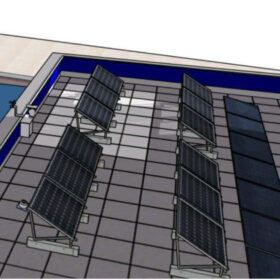
‘Cool roofs’ increase power yield in bifacial rooftop PV systems
A Spanish-Algerian reserch group has tested how “cool roofs” could help increase power yield in rootop bifacial PV systems. Cool roofs are based on coating materials with high reflectance properties.

Sweden’s Epishine expands indoor PV module manufacturing capacity
Epishine, an organic PV module manufacturer, has completed a new factory in Linköping, Sweden. The facility uses roll-to-roll equipment to produce new products for low-power battery replacement and the self-powered electronics market.
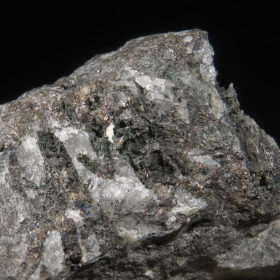
Kesterite solar cell achieves 12.01% efficiency via selenization approach
The Chinese Academy of Sciences (CAS) has used a new selenization approach to build a kesterite solar cell with better charge transport and power conversion efficiency. China’s National PV Industry Metrology and Testing Center (NPVM) has certified the results.
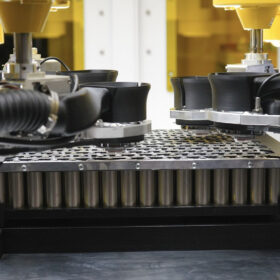
Laser-sharp focus on interconnections
As the world’s solar manufacturers continue to ramp up production at an eye-watering speed, a cell connection technique up to 10 times faster than the industry standard holds rich promise, according to Keven Tremblay, from Canadian laser process specialist Laserax.
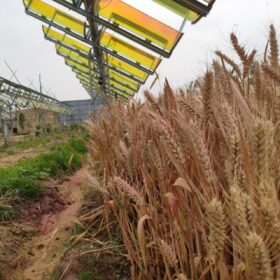
Agrivoltaic system achieves 9.9% efficiency, LCOE of $0.033/kWh
Researchers in China have built a prototype of a spectral-splitting concentrator agrivoltaic system (SCAPV) with a PV efficiency of 9.9, a hybrid light-use efficiency rating of 9.05%, and a levelized cost of energy (LCOE) of $0.033/kWh.
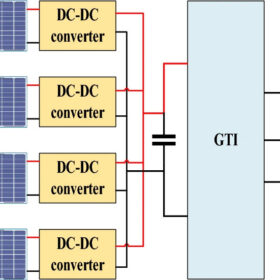
New MPPT approach for multi-string PV systems under partial shading
Egyptian researchers have developed a multi-string PV system with a converter control strategy, achieving 99.81% efficiency with a direct duty cycle for maximum power point tracking (MPPT).

European consortium targets 25% CIGS solar cell efficiency
A consortium of European thin-film PV manufacturers and research institutes are working to advance copper, indium, gallium, and selenium (CIGS) solar development in a €5.9 million ($6.4 million) project. It aims to achieve 25% cell power conversion efficiency by improving manufacturing processes and scaling up from lab-sized bifacial devices to small outdoor-tested modules for a range of applications.
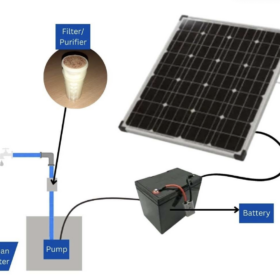
Kenyan startup offers PV-powered water filter
Inno Neat has developed a solar-powered water filter that removes contaminants such as bacteria, viruses and heavy metals for rural communities.
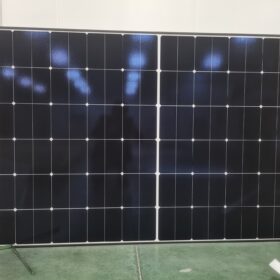
Hanersun launches ABC solar module series with up to 23.2% efficiency
China’s Hanersun has unveiled its new HItouch 5A module series, which is based on ABC cell tech and 182 mm wafers. The output ranges from 430 W to 600 W and the efficiency ratings are between 22.0% and 23.2%.
