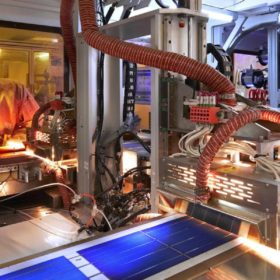
Trina Solar improves efficiency of 210 mm PERC solar cell by 0.5%
The cell has achieved a power conversion efficiency of 23.5%. The result was confirmed by China’s National Center of Supervision and Inspection on Solar Photovoltaic Product Quality (CPVT).
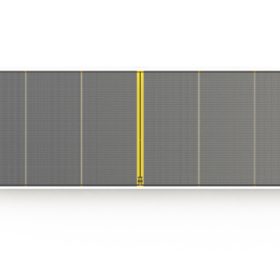
Ultra-lightweight CIGS solar module for high altitude airship applications
The 25 W solar panel has been designed to operate at air mass zero (AM0), which is the standard spectrum outside the Earth’s atmosphere. According to the PV manufacturer, the module has a weight of just 82 grams, while a small 300 W array comprised of these panels would weigh in at around 1 kg.

US customs enforcement is jeopardizing 2.1 GW of solar projects
Solar product detentions at U.S. ports of entry all stem from a June 24 “Withhold Release Order” issued by Customs and Border Protection.
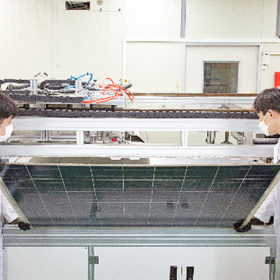
Novel PV module recycling tech from South Korea
Developed by the Korea Institute of Energy Research (KIER), the “non-destructive” technology is claimed to enable the recovery of 100% of a module’s glass and to allow the reuse of silicon for producing new solar cells with an efficiency of 20.05%.

Daqo CEO predicts polysilicon price will keep on rising
While some analysts have said the raw material shortage has eased sufficiently of late for its selling price to stabilize, the chief executive of Xinjiang-based producer Daqo made bullish statements about his company’s prospects yesterday, based on an expectation of continuing tight supply of the solar panel component.

US solar group urges government to act on claims of Southeast Asian dumping
The American Solar Manufacturers Against Chinese Circumvention has filed three petitions urging the U.S. Department of Commerce to investigate allegations of “unfairly traded imports” from three countries in Southeast Asia.
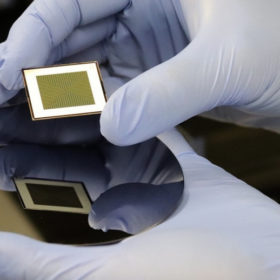
Australian researchers develop bifacial solar cell with 96.3% bifacial factor
Australian National University researchers claim to have set a world record for bifacial solar cell efficiency that they say could boost the energy output of solar farms by 30%.
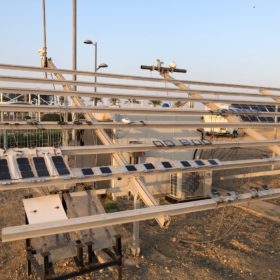
Tracing the roots of fill factor degradation in perovskite-silicon tandem solar cells
Scientists in Saudi Arabia have conducted one of the longest tests on the stability of perovskite-silicon tandem solar cells. According to their findings, the most affected parameter under the hot and humid climate of the region is the device fill factor, which dropped from 80% to 50% in just six months.
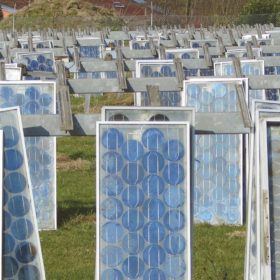
Blockchain for PV module recycling
Next Energy and Marubeni are developing a blockchain tech for PV module inspection – with the support of the Japanese government – which they claim is able to provide data on a panel’s traceability and components as well as verifying that the data were not modified or tampered with.
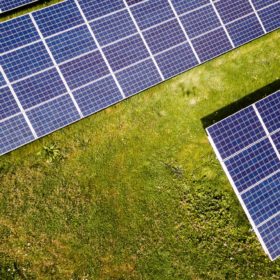
China made 14 GW of solar modules in June – and more than 80 GW in six months
The nation produced 57% more solar cells in the first half of this year than in the same period a year earlier, according to a financial update from state-controlled manufacturer Luoyang Glass.
