
General manager of GCL subsidiary approved $79m contract payment against company policy
While the independent investigation of a payment handed over to a state-owned lead contractor for a polysilicon fab planned by GCL exposed a breach of internal policy, the manufacturer has been cleared of any non-compliance with legal requirements.
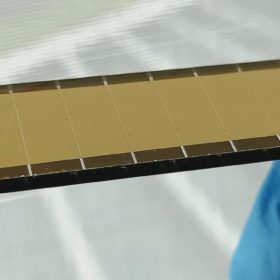
Two years of perovskite progress
Scientists in China examined some of the key achievements in the development of perovskite solar cells in 2020 and 2021. The group finds that translating laboratory achievements onto larger, manufacturable devices, is the biggest challenge, and sees continuing collaboration between the industry and academic researchers as the key to overcoming this challenge.

New PV system assembly factory in Brazil
The factory will be located in the state of Ceará and is expected to begin manufacturing activities in 2022.

Chinese PV Industry Brief: News of 360 MW project win in Nigeria and TBEA benefits from poly shortage
State-owned China Xinhua Power Development has booked a $53 million discount on seven solar farms as developer Kongsun seeks to pay down debts, and Canadian Solar has landed a 45 MWh energy storage contract in Colombia.
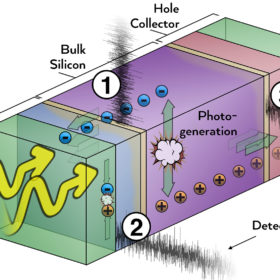
Bringing the noise for better solar cell efficiency
An international team of scientists developed a technique to isolate individual sources of electrical ‘noise’ within a solar cell. Comparing the technique to being able to pick out a single voice within a 200-person choir, they say the technique will help to improve understanding of where efficiency losses occur within a cell, and effective ways to mitigate them.
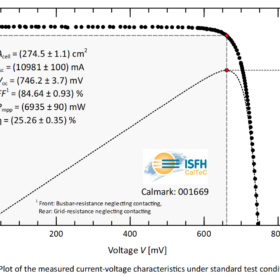
Huasun achieves 25.26% efficiency for heterojunction solar cell
The result was confirmed by Germany’s Institute for Solar Energy Research in Hamelin.
Inverted perovskite solar cell with 22.1% efficiency via star-shaped polymer
The solar cell was fabricated with a special polymer that is able to passivate defects at the grain boundaries and interfacial surfaces, inhibit nonradiative recombination and charge-transport loss, and improve stabilities under moisture. The device exhibited a remarkable fill factor, of 0.862.
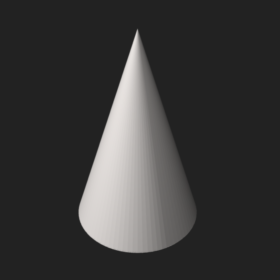
Conical-shaped solar panels cooled by forced airflow
A group of international scientists has compared the hypothetical performance of three novel shapes of solar modules – pyramidal, hexagonal and conical – and has found the latter has the strongest potential in terms of thermal behavior. According to their findings, a cooling technique based on forced airflow is key to making these solar module shapes into a feasible solution.

Xinyi suffers setback in EU anti-dumping case
The Chinese solar glass maker, which claimed a positive legal judgement in the European General Court in 2019, is now likely to have that victory set aside by the European Court of Justice, with an advocate-general saying the company benefited from an income tax regime which may have unfairly distorted its operations.
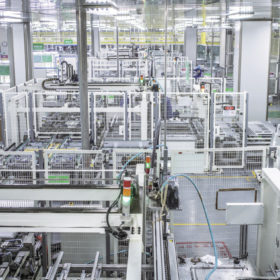
JinkoSolar claims 23.53% efficiency for n-type, TOPCon, monocrystalline panel
The PV module relies on Jinko’s TOPCon mono cell technology, for which a record efficiency of 25.25% was announced in late May. TÜV Rheinland has confirmed the result.
