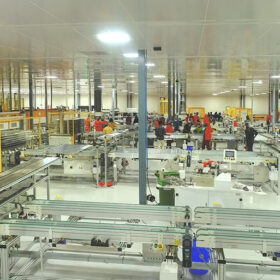
Vikram Solar moves entire module portfolio to G12R
Vikram Solar Ltd today announced the adoption of G12R format across its entire PV module portfolio. The company said the move reflects broader industry trends toward larger-format wafers, high-efficiency n-type technologies, and bifacial module designs aimed at improving energy yield and project economics.

Chinese PV Industry Brief: Major solar manufacturers report steep full-year losses
JA Solar, TCL Zhonghuan, JinkoSolar, Trina Solar and Daqo each announced significant losses for full fiscal year 2025 amid continued price declines and overcapacity.
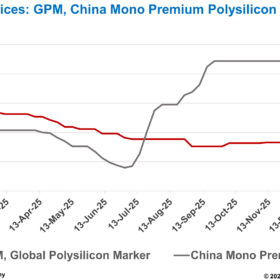
Compliance premiums lift global polysilicon prices
In a new weekly update for pv magazine, OPIS, a Dow Jones company, provides a quick look at the main price trends in the global PV industry.

Oxford PV targets 20-year lifetime for perovskite-silicon tandem modules by 2028
Oxford PV CEO David Ward spoke with pv magazine about the prospects of its company and the perovksite-silicon tandem PV technology at the WFES event in Abu Dhabi. He said Oxford PV is expanding manufacturing beyond Germany while focusing on global licensing partnerships.

Tesla offers new all-black solar module for residential applications
The launch of the new product suggests Tesla could renew its focus on residential solar and expand U.S. lease options with Powerwall.

Not all POE encapsulants protect TOPCon solar cells from corrosion
UNSW researchers found that some POE encapsulants can trigger severe corrosion in TOPCon solar modules, causing up to 55% power loss under damp-heat conditions. Their study highlights that module reliability depends on the exact encapsulant formulation, not just the polymer type.

Solar modules under pressure: The growing risk of spontaneous glass breakage
Once considered isolated incidents, spontaneous glass breakages in solar modules are becoming more frequent, highlighting the limits of some manufacturing choices and the need for closer quality control.

Canadian Solar wins U.S. patent litigation against Maxeon
The patent infringement case was related to an unspecified TOPCon solar cell technology.

The eyes and ears of the power grid
Sensors are an indispensable tool to inform utility managers of the state of the electricity grid and the occurrence of disruptions of any kind. The IEC provides the standards and conformity assessment that enable them to operate safely and efficiently.
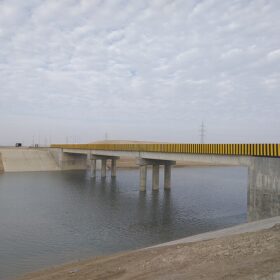
Canal-top PV for Afghanistan’s massive irrigation project
A team of scientists has simulated covering 20% of the Qush-Tepa irrigation canal with PV panels. To this end, the researchers developed a framework, termed an integrated techno-economic-environmental assessment, that can be applied elsewhere. “It explicitly quantifies energy production, water-evaporation reduction, land-use savings, and economic performance within a single analytical structure,” one of the researchers said.
