
New all-black module with output of 400 W
Solaria says that it will start selling its new all-black panel for residential PV applications in the U.S. market within the current quarter. The monocrystalline module is equipped with a microinverter from Enphase and has an efficiency rating of 20.2%.
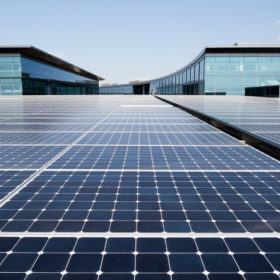
SunPower pauses its solar cell and module factories, reduces salaries and workweek
The solar efficiency leader remains on track to complete its planned split into two independently focused pure-play solar companies by the end of the second quarter.

Australian researchers take solar windows to the next level
The building-integrated PV devices have taken a big leap forward on the back of a partnership between Australian scientists and a major glass manufacturer which will investigate the use of semi-transparent solar cells in commercial applications, potentially revolutionizing building design.

New manufacturing technique for 26%-efficient tandem perovskite solar cell
U.S. scientists have demonstrated a perovskite-silicon tandem cell they claim has low reflectance losses and strong potential for commercial production. The tandem architecture involves a manufacturing process featuring the solution-based blading of perovskites onto textured silicon wafers.
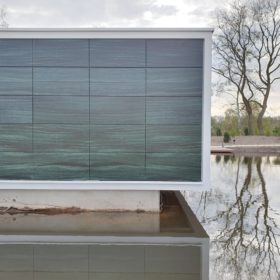
Wood-like solar facades
Taiwanese manufacturer Heliartec Solutions is offering BIPV panels for building facades that can be designed to mimic different kinds of textures in conventional building materials. The panels can also work as colored laminated safety glass and replace traditional cladding in the ventilated facades of buildings. They vary in length from 60 cm to 240 cm, with widths ranging from 30 cm to 120 cm. Depending on their size, the panels can offer power outputs of 90 W to 150 W per square meter.
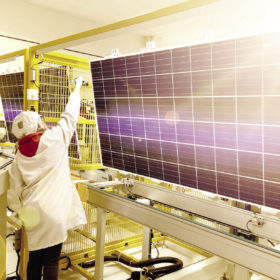
Canadian Solar calls Solaria’s ‘shingled’ cell patent claim ‘meritless and unfounded’
The patent infringement claim concerns a process for separating photovoltaic strips from silicon solar cells for use in more-efficient tiled or “shingled” solar panels.
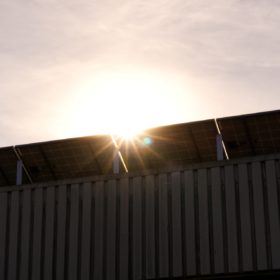
New technique to determine best cooling technique for solar modules
A new paper published by researchers at Malaysia’s Multimedia University provides a new method to assess the effectiveness of different cooling systems for photovoltaic modules. The proposed technique relies on measuring the output of the module with added cooling and comparing this to its power rating under standard test conditions.

Renewables and geopolitics: Who will ‘win’ the energy transition?
The losers in a world which no longer runs on fossil fuels are obvious but the dividend from shrugging off hydrocarbon dependency will be spread around most of the world so it is the nations which are winning the cleantech manufacturing and intellectual property race which appear best positioned for the future.
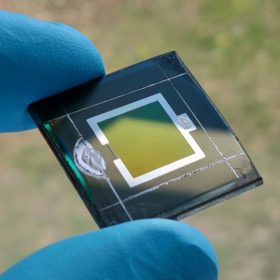
HZB scientists announce 24.16% efficiency for tandem CIGS solar cell
The Fraunhofer Institute for Solar Energy Systems’ (ISE) CalLab has confirmed the new efficiency rating. The researchers have combined semiconductors, perovskites and CIGS to produce a monolithic two-terminal tandem cell.
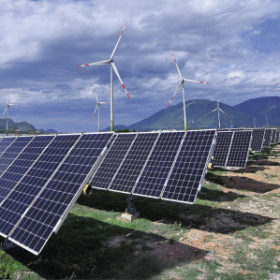
Covid-19 daily bulletin: Renewables squeezing out fossil fuels as energy demand plunges
Although the energy price recovered this week, ultra low levels driven by bumper solar power generation on a sunny weekend in Germany reportedly put further pressure on the business case for conventional energy.
