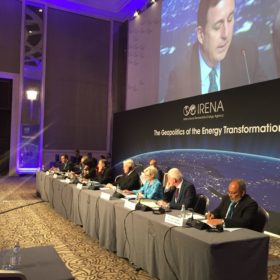
‘Renewables must grow four times faster to ensure sustainable future’
The share of renewables in the global energy mix must more than double by 2030 for the world to advance the energy transition and achieve sustainable development goals, according to the International Renewable Energy Agency. Renewable electricity should supply 57% of global power by the end of the decade, up from 26% today.

SolarPower Europe repeats call for solar strategy as part of European Commission’s €1tn Green Deal
Lobby group CEO Walburga Hemetsberger says the plans announced by commission president Ursula von der Leyen this week should place the European solar industry front and center.
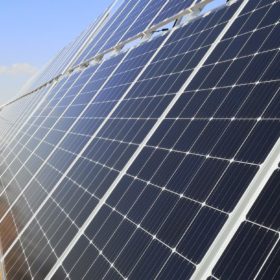
Jolywood says 105 MW Oman project demonstrates value of n-type
As it moves towards grid connection this month, the solar project in the south of Oman demonstrates the value proposition of n-type PV cell technology, Chinese solar manufacturer Jolywood has argued at the World Future Energy Summit. The project is said to be the largest n-type bifacial array in the world.
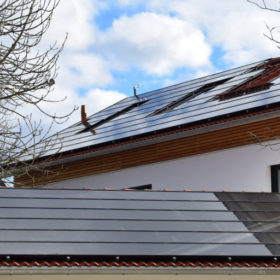
Hard times for thin-film PV module makers as Crystalsol and Calyxo file for insolvency
Calyxo, a German cadmium telluride solar module manufacturer, has filed for insolvency for the second time, despite the recent emergence of new prospective investors. Meanwhile, Crystalsol – an Austrian flexible solar panel maker – has also initiated insolvency proceedings, due to losses of roughly €7 million.

South Korean government reassures domestic PV industry
The country’s Ministry of Trade, Industry and Energy (MOTIE) has provided new market share figures for the domestic PV sector that contradict recent media claims that Chinese manufacturers have been aggressively ramping up their local presence at the expense of Korean module makers. The government has also confirmed plans to prioritize PV projects made with low-carbon, high-efficiency modules.
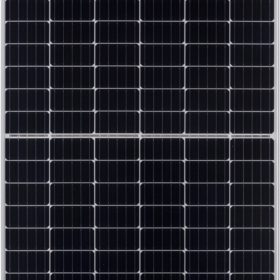
Half-cut modules from Sharp
The Japanese electronics giant has unveiled three monocrystalline half-cut cell modules said to provide 2-3% better performance than standard, full cell panels. The claimed efficiency of the modules exceeds 19.5% and Sharp says power output ranges from 330-395 W.

Solar cells from space are on the way
A team at the U.S. National Renewable Energy Laboratory has come up with a new process that would reduce the production cost of highly expensive – and highly efficient – gallium arsenide cells.

First Solar reaches $350m legal settlement with shareholders to halt 2012 lawsuit
The U.S. thin-film manufacturer continues to deny having misled stockholders over solar module defects between 2008 and 2012 and said the settlement had been reached to close the historic legal action and permit the company to remove the uncertainty associated with it.
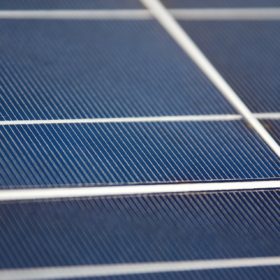
UK researchers confirm correlation between micro-cracks and hot spots in polycrystalline cells
A research team from the University of Huddersfield used electron microscopy to analyze micro-cracks in 4,000 polycrystalline silicon solar cell samples. The results showed power losses may vary from 0.9-42.8%, and increased temperatures due to micro-cracking may favor the formation of permanent hot spots in the cells.
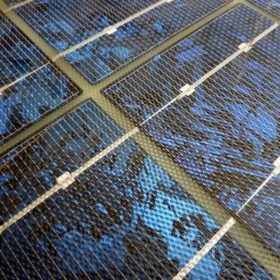
US scientists claim clear-sky irradiance model provides better results for module testing
Researchers at the American Institute of Physics have used the clear-sky irradiance model developed by the National Renewable Energy Laboratory to measure the degradation rates of solar panels at a testing field in Germany over five years. The scientists say the model, when combined with real-world data, offers an efficient tool to evaluate the aging of PV technology.
