
Has solar lost its sheen for India’s EV push?
While the nation’s recent Union budget announced steps to create an electric vehicle market, the solar sector still has issues that have not been addressed.
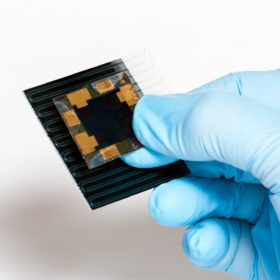
Miasolé sets new flexible CIGS efficiency record
U.S. based Hanergy subsidiary Miasolé has achieved a record 17.44% conversion efficiency for a large area flexible CIGS module. The record has been confirmed by the Fraunhofer Institute for Solar Energy Systems.
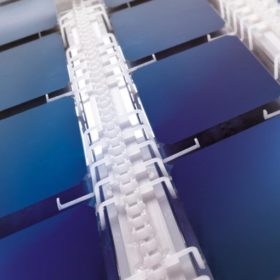
German PV equipment suppliers export 99% of their products
First-quarter figures from German engineering association the VDMA showed that, while orders picked up after a slow end to last year, almost all PV production equipment produced in the country is shipped abroad, with China the leading destination.
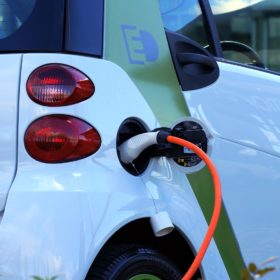
Indian ministry calls for EV manufacturing equivalent of Detroit
The nation’s annual Economic Survey placed EVs at the heart of India’s decarbonization and called for an industrial hub where electric vehicles and the batteries to run them could be manufactured.

Unlocking lithium metal’s stored potential
Several new concepts in lithium-ion storage technology have the potential to greatly the increase the energy capacity of batteries. Among them are lithium metal anodes, which could potentially increase energy density by more than 50%. With a newly optimized electrolyte, scientists at the University of California, San Diego have taken another step toward making the idea a commercial reality.

Growing interest in energy storage for maritime applications
The Electric and Hybrid Marine World Expo in Amsterdam last week highlighted growing interest in storage technology from the sea vessel industry. Leading global battery manufacturers had their latest charging technologies on display, catering to rising demand for clean, efficient electric and hybrid marine systems.

Single-walled carbon nanotubes go into industrial production in China
The material is a conductive additive for silicon anodes in lithium-ion batteries, helping to improve cycle life and increase energy density. It has taken decades to bring the nanotubes into commercial production.
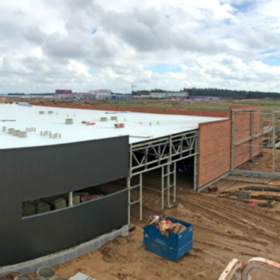
Recom announces construction of 300 MW module factory in Belarus
The German solar panel manufacturer – now based in France – says it is in the final phase of constructing a module factory to increase its European production capacity after a plethora of similar announcements across the continent.
Oxford PV receives $43m investment from Meyer Burger and others
The British-German perovskite startup has closed series D funding with another £34 million to bring the money raised in the round to £65 million.
Battery maker CATL ramps up investment in German gigafab to €1.8 billion
Previously, a mere €240 million was set to flow into the giga-factory. The corporation’s management reasoned new demand for its battery cells made more investment necessary.
