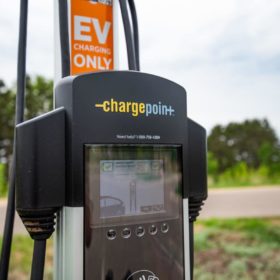
Powering EV charging stations with agrivoltaics
US researchers find that placing agrivoltaic installations along highways to power EV charging stations can reduce both carbon emissions and range anxiety.

German consortium plans to build world’s largest heat pump
Basf and Man Energy announced a plan to build a 120 MW renewables-powered heat pump for steam production at an industrial site operated by Basf in the Rhineland-Palatinate region, Germany. The feasibility study for the project should be completed by the end of this year.
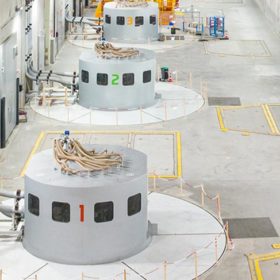
Massive pumped-hydro storage facility comes online in Switzerland
The Nant de Drance facility began commercial operations on July 1 and is currently one of Europe’s largest pumped-hydro storage stations.
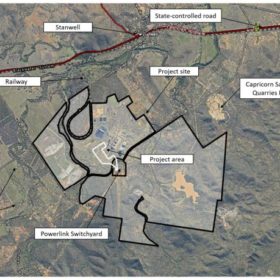
Australian coal power plant to host massive 1.45 GW/2.9 GWh battery
Queensland government-owned energy generator Stanwell has revealed plans to a build a massive 1.45 GW/2.9 GWh battery storage system alongside the coal-fired Stanwell Power Station in central Queensland as the state government looks to ramp up energy storage capacity to support the transition to renewables.
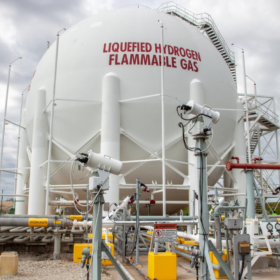
The Hydrogen Stream: Romania calls for green hydrogen projects
Romania has unveiled a state aid scheme to support investments in the production of hydrogen powered by solar, hydro and wind, while Air Products and Gunvor have agreed to build a hydrogen import terminal in Rotterdam.
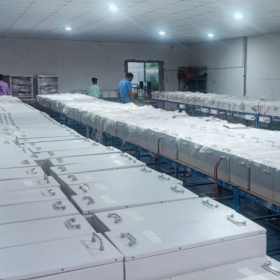
Indian manufacturer plans new lithium battery factory
India’s Sanvaru is expanding its lithium battery production capacity to 400 MWh per year by setting up a new factory in the Indian state of Uttarakhand. Its devices are used for stationary and EV storage.
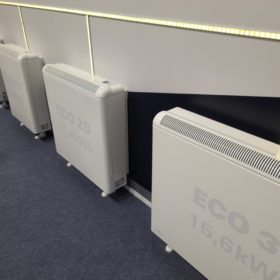
Solar-powered residential heating system based on storage heaters
Spanish heating specialist Elnur Gabarron offers a residential heating system that works with surplus solar power and storage heaters. The system can work as a backup solution, combined with existing conventional heating, or as a household’s main heating system, with minimal use of grid electricity.

Storing solar power via borehole thermal energy storage
A Chinese-Finnish research group has proposed the use of seasonal, soil-based thermal energy storage in combination with photovoltaics in residential districts. They have found that the hybrid concept could cover up to 58% of total heating demand.
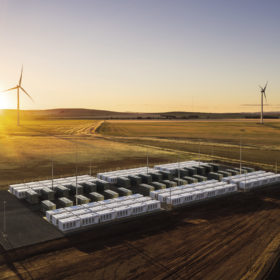
Tesla big battery operator fined for breaching Australian power rules
The operator of the 150 MW/193 MWh Hornsdale Power Reserve in South Australia has been fined AUD 900,000 ($620,470) for failing to provide essential services to maintain the stability of the grid.
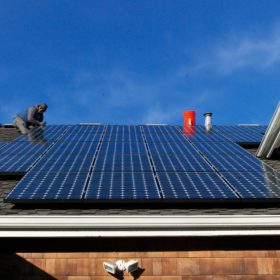
California ruling simplifies grid-connection process for distributed solar, storage
The California Public Utilities Commission has introduced a new rule to streamline the interconnection process for distributed energy resources.
