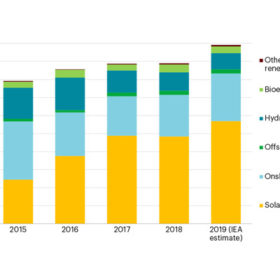
International Energy Agency forecasts 115 GW of new solar this year
The global expansion of PV, wind power and other clean energies will see double-digit growth this year as solar continues to lead the pack.

Canada’s Saskatchewan province to halt net metering for solar
Utility SaskPower is set to close the net metering open to systems up to 100 kW in size once a 16 MW cumulative generation capacity limit is reached in the province.
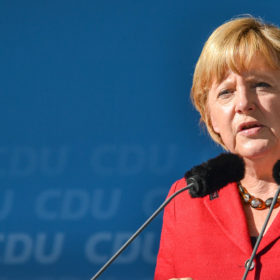
Germany lifts cap on solar FIT program with new Climate Change Act
While the solar industry will welcome the move, the feed-in tariff paid to small systems is still reducing thanks to the volume of new capacity installed every quarter. Announcing a wide-ranging policy package on Friday, Angela Merkel admitted Germany will miss the carbon emission target set for next year.
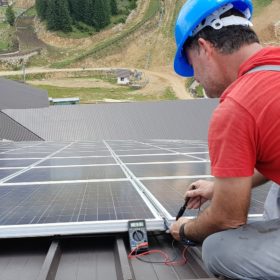
Live fast, die young: MIT study proposes use of 10-year panels
Research has found even short-lived, 10 to 15-year solar panels could provide enough return for bankable projects. The researchers believe panel costs, coupled with an industry mindset now fixed on the final solar energy price rather than costs per kilowatt installed, may open opportunities for PV products currently snubbed because of a short lifecycle.

Mongolia tenders 10 MW solar plant
The project, planned for Khovd in the west of the country, is being developed with the support of the World Bank.
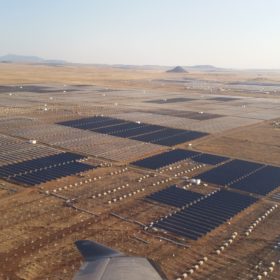
South Africa’s water-energy nexus leaves room for improvement
A team of researchers modeled the country’s energy future, finding that the drought plagued municipalities could benefit massively from large scale renewables deployment. The current reliance on coal-fired power stations causes immense water consumption, worsening the problem.
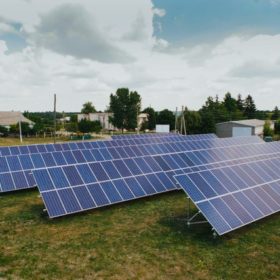
Moldova proposes renewables tariffs
The energy regulator has proposed a 15-year payment of $0.10/kWh for PV projects with a generation capacity of 10 kW-1 MW. The first auctions for large renewables projects are planned for early next year and will grant a fixed rate rather than a variable premium.

A common language for bifacial PV
This week pv magazine was in Amsterdam for the sixth edition of the BifiPV workshop, where the discussion focused on the impressive achievements made by bifacial solar modules and the challenges the technology faces as it moves toward mainstream adoption.
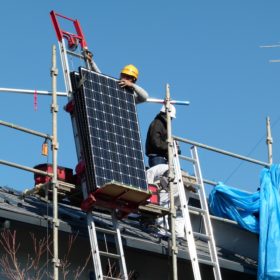
Austria mulls mandatory PV as new rebates for solar and storage launched
With the region of Styria considering making PV mandatory on all new buildings, the nation’s Climate Fund will support PV and storage projects in agriculture and forestry. Applications can be submitted by November 2020 – or until the pot is empty.

‘Mono will supply 80% of the world’s solar by 2021’
Polysilicon manufacturer Daqo has announced the start of pilot production in Xinjiang and expects to ramp up to full output by the end of the year, doubling the company’s annual capacity to 70,000 MT. Some 90% of its poly will be mono by that stage and Daqo expects 40% to be suitable for n-type products next year.
