International Energy Agency forecasts 115 GW of new solar this year

From pv magazine Germany.
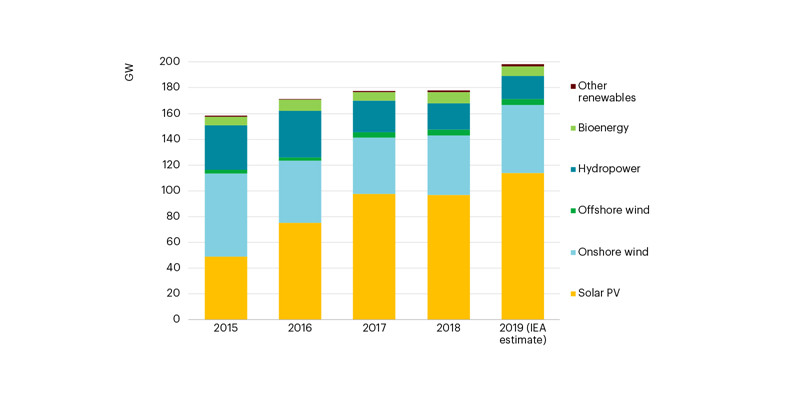
After stagnating last year, renewable energy has hit back with a vengeance in 2019 with the International Energy Agency (IEA) expecting almost 200 GW of new clean energy generation capacity will have been added by year-end.
The lion’s share of the new capacity will come from solar – 115 GW of it despite a small decline in China – as PV and wind offer very much the mainstream options.
Rapid solar power adoption across EU member states, particularly Spain, will offset the dip in the world’s biggest market according to the IEA, which also picked out Vietnam, India, the U.S. and Japan as fast-expanding solar markets. In fact the only uncertainty cited in the latest IEA forecast concerned the unpredictable Chinese marketplace.
This year PV will crack the 100 GW mark globally for the first time, helped by a more-than-80% fall in solar prices since 2010 as PV becomes the largest clean energy technology deployed for the third year running, according to IEA predictions.
Not enough
But the deployment seen this year will still fall well short of the 300 GW of new renewable energy capacity required annually from 2018 to 2030 to meet the IEA’s ‘sustainable development’ scenario. The agency – often criticized for low-balling its solar estimates and recently accused of peddling the myth of natural gas as a low-carbon energy source by German thinktank the Energy Watch Group – criticized Chinese policymakers for their abrupt decision to rein in public solar subsidies in May last year. That u-turn was a primary contributory factor in the volume of renewable energy deployed worldwide failing to rise in 2018, the first time that had occurred in 17 years.
“We are experiencing a dramatic decline in the cost of solar power, coupled with strong onshore wind growth,” said IEA executive director Fatih Birol. “And the offshore wind is showing encouraging signs. These technologies are the cornerstones of global efforts to combat climate change, reduce air pollution and provide energy access for all.”
The IEA estimates the onshore wind market will grow 15% to 53 GW this year, driven by new installations in the U.S. and China. The increase in offshore wind energy is expected to remain stable at around 5 GW in 2019, led by the European Union and China.
This content is protected by copyright and may not be reused. If you want to cooperate with us and would like to reuse some of our content, please contact: [email protected].

Please login to comment

[…] support and subsidies. Fast forward to 2019 and the International Energy Agency (IEA) says that more than 115 gigawatts (GW) of solar were installed across the world in 2019. This is more than all other generation […]
[…] latest edition of the Renewables Market Report published by the International Energy Agency (IEA) has warned that if the higher costs which have driven up the price of solar panels this […]
[…] latest edition of the Renewables Market Report published by the International Energy Agency (IEA) has warned that if the higher costs which have driven up the price of solar panels this […]
[…] IAEA Imagebank/FlickrThe latest edition of the Renewables Market Report published by the International Energy Agency (IEA) has warned that if the higher costs which have driven up the price of solar panels this year […]
[…] 2019 alone, there were more than 115 gigawatts(GW) of solar energy harvested around the world. This is more than all other generations combined. In […]
[…] highly dependent on subsidy regimes in countries such as Germany and Italy. This year there will be more than 115 gigawatts (GW) of solar installed across the world, which is more than all other generation technologies put […]
[…] the most sobering aspect of the technology innovation report published today by the International Energy Agency (IEA) is how the advent of Covid-19 appears to have quietly pushed back the deadline for combating […]
[…] This year alone it’s expected by the International energy agency that more than 115 gigawatts (GW) of new solar installations across the world. Over the past decade, the cost of solar has fallen dramatically and definitely the new technologies promise to increase efficiency and lower costs further thus making the solar energy to be unbeatable comparing to fossil fuels.[1] […]
[…] PV Magazine: […]
[…] Solar power electronic devices convert electricity from one form to another using photovoltaic inverters and battery chargers or dischargers. Power electronics enable solar grid integration and grid modernization technologies, as the forecast suggests that 80% of electricity would need some form of power electronics. This creates a need to improve integrating systems such as inverters, converters, rectifiers, and trackers at various stages and power ratings that support utility-scale, commercial, industrial, and residential photovoltaic systems. [1] […]