
Italy’s January-September solar installations hit 3.5 GW
Italy deployed more than 3.51 GW of new solar in the first nine months of 2023, bringing its cumulative installed PV capacity to 28.57 GW at the end of September, according to the national energy agency.

The solar module surplus: EUPD Research considers Europe’s warehouse woes
As solar module prices continue to drop to record lows, amid global oversupply, questions are being asked about how much inventory is sitting in European warehouses and when normal levels will return. With numerous estimates and assumptions swirling, EUPD Research’s Markus A.W. Hoehner and Ali Arfa have looked closely at the numbers in an attempt to provide a transparent view of the issue.
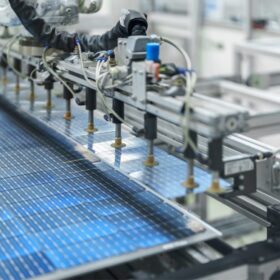
Voltec Solar secures funds to make perovskite-silicon tandem modules
Voltec and the Institut Photovoltaïque d’Île-de-France (IPVF) plan to set up a pilot line for their new tandem panel tech in 2023 and their first 200 MW industrial demonstrator in 2025. They also plan to increase the factory’s capacity to 1 GW in 2027 and 5 GW by 2030.
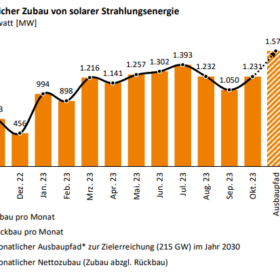
Germany’s January-October solar capacity additions hit 11.7 GW
Germany installed 11.7 GW of new solar capacity between January and October 2023, with 1.23 GW added in October alone, bringing the nation’s cumulative installed solar capacity to 79.2 GW.
Only 3 Portuguese energy communities operating despite massive demand
The European Commission first set up the rules for energy sharing communities in 2018 and 2019, with Portugal rolling out its own legislation soon after. Despite these efforts, five years on there are only three energy sharing communities legally operating in the Mediterranean country, with hundreds more stuck in a year-long regulatory backlog, one local engineer tells pv magazine.
Dynamic allocations increase financial savings in energy communities
A global research group has compared static, customized dynamic, and dynamic-by-default energy allocations at a collective self-consumption project in France. They have found that dynamic customization performs better due to tax benefits.

EU Parliament’s vote on Net-Zero Industry Act prompts mixed reactions
European solar lobby groups have mostly welcomed the European Parliament’s recently supported EU Net-Zero Industry Act, which is aimed at strengthening the region’s renewables manufacturing sector. However, two groups are divided over a clause in the Act that limits tendered project’s from using technology partially made outside Europe.

India set for 16 GW of solar this fiscal year amid falling module prices
Falling PV module prices are set to enhance investment returns for the 45 GW of solar projects that have been awarded since fiscal 2021, with expectations for 16 GW of new capacity in the current fiscal year, says CRISIL Ratings.

Former coal-plant big batteries win Australian storage tender
More than 1 GW of firmed storage capacity is set to be delivered by six winning projects from a recent tender in the Australian state of New South Wales. Akaysha Energy’s 415 MW/1,660 MWh battery in Wellington and AGL’s 500 MW/1,000 MWh Liddell battery are the round’s two biggest projects.

The Hydrogen Stream: EU to launch 2nd green hydrogen auction in spring
As the European Union launches the first pilot auction this week, it also announces it will double down in spring, while also supporting a collaboration with Brazil for the construction of a production facility to be used in Croatia.
