
EBRD and pensions investor announce €500m, five-year climate package
The ILX pension fund investor set up with the backing of German, Dutch and British public money has committed to join the EBRD in providing the finance for climate-related investment across the lender’s sphere of influence.
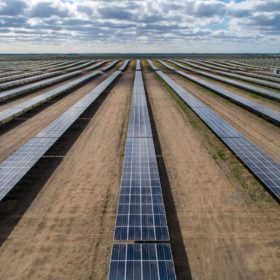
Investors submit 34GW of wind, solar, storage for renewables zone in Australia
The New South Wales state government in Australia has revealed that more than 34GW of new solar PV, wind and energy storage projects have been proposed for the South-West Renewable Energy Zone.

US government extends Section 201 tariffs on imported PV panels, cells
The Biden administration has upheld an exclusion for bifacial panels in its new extension of Section 201 tariffs, while ramping up the annual tariff rate quota for cells to 5GW.
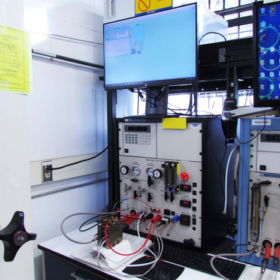
The Hydrogen Stream: New fuel cell design to solve longstanding problem of overheating
Los Alamos National Laboratory researchers developed a new polymer fuel cell that is claimed to solve the long-known issue of overheating. Furthermore, Mexican cement producer Cemex invested in HiiROC, a UK-based hydrogen production startup, which developed a scalable technology that uses thermal plasma electrolysis to convert biomethane, flare gas, or natural gas into hydrogen at a reportedly lower cost than competing solutions.

Forget batteries, what if surplus renewable energy could be stored as information?
A pair of researchers from UC San Diego has proposed to precompute certain data when the grid is flooded with solar or wind power, and then store it on servers for later use.
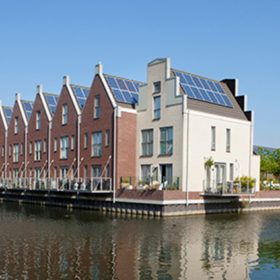
Around 90% of newly built homes erected last year in the Netherlands are gas-free
The Netherlands is at the forefront of promoting sustainable heating in Europe and the share of new buildings that are not connected to the country’s gas grid may soon approach 100%.
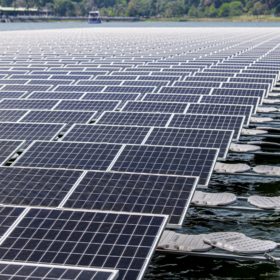
Thai utility EGAT launches tender for hybrid project combining hydro, floating PV and storage
The Ubol Ratana Dam Hydro-Floating Solar Hybrid Project will have a capacity of 24 MW and will be located the company’s Ubol Ratana Dam in Khok Sung, Ubolratana District.
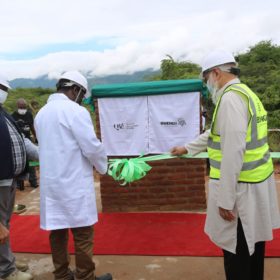
Work begins on 50 MW solar park in Malawi
The Bwengu Solar PV Power Plant will spread over 105 hectares of land and is expected to be built at a cost of $65 million within 12 months. The facility will be located in Ulalo Nyirenda village, which is just 1 km from the Bwengu Escome Substation power grid.
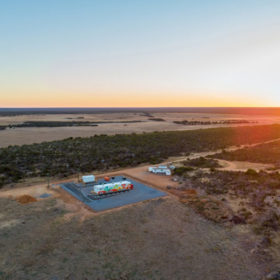
Australia’s largest microgrid goes online
The Western Australian coastal town of Kalbarri can now be powered by an entirely renewable energy solution utilizing rooftop solar and wind generation coupled with battery storage with state government-owned utility Western Power confirming the state’s largest renewable energy microgrid has been commissioned.
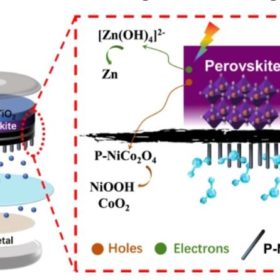
PV-powered rechargeable aqueous zinc battery
Conceived by scientists in China, the device combines an integrated carbon-based perovskite solar cell module with a rechargeable aqueous zinc metal cell. The proposed system achieved an overall efficiency of 6.4%, and a steady operation for more than 200 cycles with little performance degradation.
