
Solar, wind and storage can provide seven key grid services
Former NREL employee pens paper to rebut claims conventional energy can supply the essential grid services needed to return to normality after network disruption. The author says claims renewable energy cannot provide such services are erroneous.
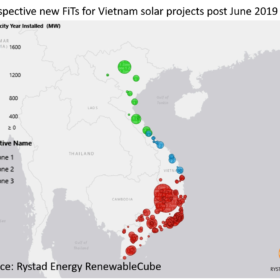
Vietnam mulls multi-layered FIT scheme as it kicks energy transition into gear
With its feed-in tariff set to expire at the end of June, Vietnam is considering different levels of payment, classified across three irradiation regions and involving four solar technologies. Future payments would range from $0.0659-0.0985/kWh, with the cloudy north in line for the highest tariffs and with the government likely to revise tariffs for new projects every two years.
South Africa’s load shedding nightmare may vanish with more renewables
As utility Eskom starts load shedding due to power plant failure, the 4 GW of wind and solar in the country are helping reduce energy shortages. Blue Horizon Energy Consulting Services’ Chris Ahlfeldt tells pv magazine renewables – rather than Eskom’s plans to expand conventional generation capacity – would provide a safer, cheaper solution to the power crisis.

Amprion and OGE announce 100 MW power-to-gas project in Germany
The €150 million project is entering the approval phase. Using the new facility, expected by 2023, the two companies will test how electricity from renewable energy can be converted into green hydrogen and green methane via electrolysis.

Cambodia’s 100 MW National Solar Park project moves forward
The Asian Development Bank, which is backing the plant, is seeking project consultants. If built, the solar park would improve the country’s limited power supply and bring technical benefits to the national grid.
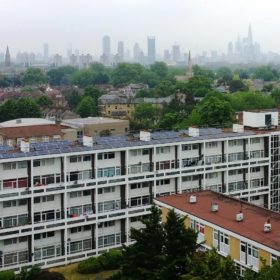
EDF helps Londoners share solar power using blockchain
The CommUNITY project is being realized outside the U.K. regulatory framework, which does not permit power trading between electricity customers.

Slovakian utility ZSE launches virtual battery for residential PV
The service, costing €2 per month, is for residential customers that use PV products provided by the power company. The system is provided by E.ON group – a shareholder in the Slovak utility – and has already been launched in Germany, Czechia and Italy.
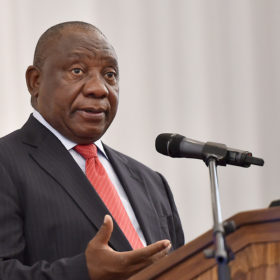
South African renewables may be boosted by plan to privatize utility
President Cyril Ramaphosa has announced a plan to rescue state-owned power company Eskom by separating it into three units. According to consultants Frost & Sullivan, although that may not be enough to completely address the utility’s financial crisis it may further encourage investment in renewables.
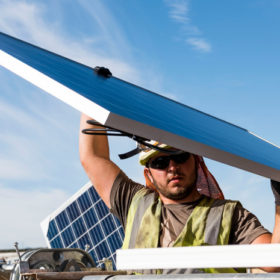
Financial backing for study of grid effects in Australia’s booming distributed generation market
The Australian Renewable Energy Agency has awarded AU$9.6 million in grants for five projects and seven studies into the role of distributed generation assets on the grid – and how to expand their penetration.
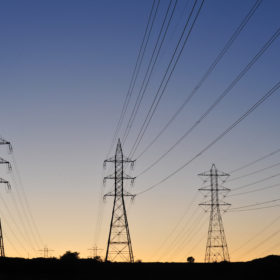
Super-grids vs prosumer states: storage may decide the battle
Indra Overland, head of the Center for Energy Research at the Norwegian Institute for International Affairs, explains how the world’s future energy landscape may include pan-regional super-grids. However, prosumer states seeking energy independence could also be in the mix. According to Overland, the two developments will go hand in hand and the balance between them will be determined by the competitiveness of storage technologies.
