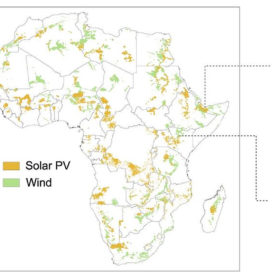
IRENA releases all-Africa dataset of locations for solar, wind
The International Renewable Energy Agency (IRENA) has published a dataset with 10,905 sites for PV deployment across Africa, with an estimated total capacity of 4.9 TW.
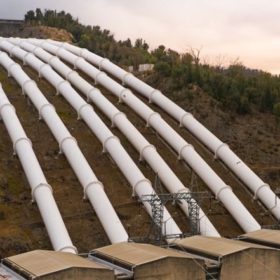
Australian companies targeting 4.5 GWh of pumped hydro storage
The developers behind a proposed AUD 5.5 billion ($3.7 billion) pumped hydro renewable energy project in Australia have announced a new partnership to pair 4.5 GW of long-duration energy storage with new renewables capacity and green hydrogen production.
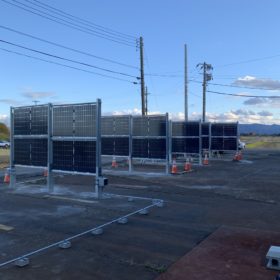
Vertical agrivoltaics for high snow loads
Luxor Solar has developed a south-oriented system for high snow loads in Japan. It features its own heterojunction solar modules, along with mounting systems from Germany’s Next2Sun and inverters from Japan’s Omron.
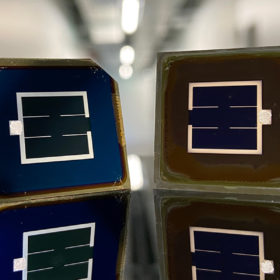
Solar cell efficiencies at a glance – updated
A research group led by Professor Martin Green has published Version 61 of the solar cell efficiency tables. The tables include a world record for a silicon heterojunction cell, announced by Longi earlier this week, as well as five more new results.
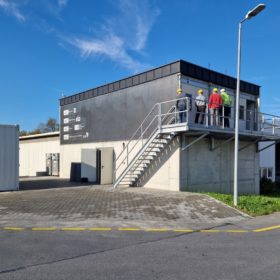
Lithium-vanadium battery for renewables storage
AMG Advanced Metallurgical Group has energized its first hybrid storage system based on lithium-ion batteries and vanadium redox flow batteries in Germany. The system reportedly combines the advantages and electrochemical properties of both storage technologies.
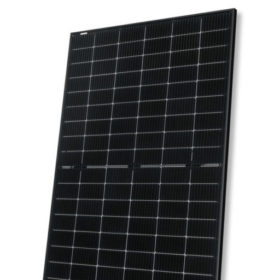
Bauer Solar unveils 420-430W bifacial glass-glass module for rooftop applications
Germany-based Bauer Solar has launched a bifacial glass-glass module series with an output of 420 W to 430 W. The new series has 108 monocrystalline n-type half cells and an efficiency of 21.51% to 22.02%.
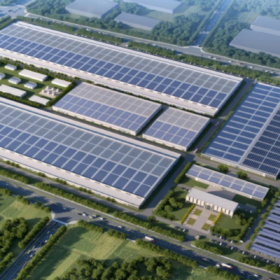
Solarspace opens TOPcon solar cell factory in China
China’s Solarspace has inaugurated the first stage of a 16 GW n-type TOPCon solar cell manufacturing facility. The facility will also start producing high-efficiency TOPCon solar modules at the beginning of 2023.
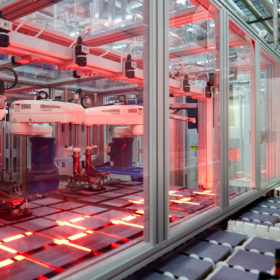
Qcells, European consortium launch production line for tandem silicon-perovskite solar cells
South Korea-based Qcells and a research group led by Helmholtz-Zentrum Berlin (HZB) have established a pilot manufacturing line for silicon-perovskite tandem cells in Thalheim, Germany. The project aims to speed up the technology’s mass manufacturing and market penetration.
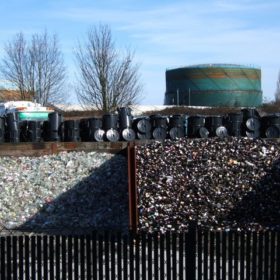
Microwave heating for glass separation in end-of-life solar modules
Scientists in Thailand have used microwaves to separate broken glass from PV panels. The process can be performed at temperatures ranging from 45 C to 55 C.
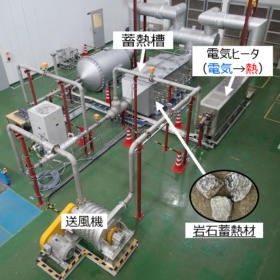
Toshiba, Marubeni launch rock-based thermal energy storage tech pilot
Toshiba and Marubeni have revealed plans to build commercial projects based on thermal storage technology using rocks. They have set up a demonstrator with 100 kWh of storage capacity and a relatively high heat storage density.
