
Longi announces world record efficiency of 28.13% for silicon solar cell
Longi claims to have achieved the world’s highest efficiency for a silicon solar cell. The result was confirmed by Germany’s Institute for Solar Energy Research Hamelin (ISFH).

U.S. startup launches PV-driven autonomous pool skimmer
The iSkim Ultra utilizes a 24 W monocrystalline solar array and a 10,000 mAh battery to provide 24/7 surface cleaning through an autonomous dual-path navigation system.

Meta gains early access to 1 GW of space-based solar power
Through an agreement with Overview Energy, Meta is seeking to bypass terrestrial grid constraints by beaming near-infared light from space to terrestrial solar plants to power high-density AI workloads.

Trina Solar claims world’s highest efficiency for silicon solar cells with 28.0%-efficient device
The Chinese manufacturer said its TOPCon-compatible hybrid back-contact solar cell achieved a power conversion efficiency of 28.0%. The result was confirmed by Germany’s Institute for Solar Energy Research Hamelin (ISFH).
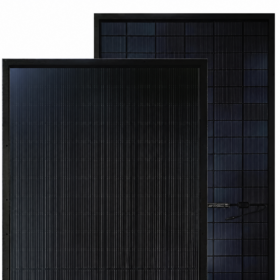
Premier Energies unveils 600-630 W all-black TOPCon solar modules
The Indian manufacturer said its new all-black panel series features a power conversion efficiency of up to 23.32% and a bifaciality factor of up to 85%.

Oxford PV says tandem solar could add up to 5 km to daily EV range
Oxford PV has joined Nissan’s SUITE consortium, advancing perovskite-silicon tandem solar tech that could boost vehicle-integrated solar EV range by an additional 3–5 km per day and push total daily solar driving range toward 15–20 km.
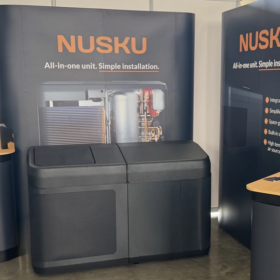
UK startup showcases all-in-one water cylinder heat pump prototype
Nusku has developed a prototype of a fully integrated air-source heat pump system that combines the heat pump with a hot water cylinder and controls into a single outdoor unit. The design aims to simplify installation and reduce space requirements by replacing separate indoor and outdoor components with one pre-packaged system.
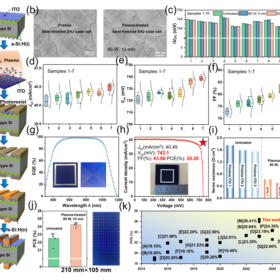
Chinese scientists build silver-free heterojunction solar cell with 25.2% efficiency
The research team developed a plasma interface engineering method to improve indium tin oxide layers, solving adhesion, contact resistance, and stability issues for copper electroplating. The optimized process enabled uniform copper metallization and boosted device efficiency to 25.2%, significantly outperforming untreated reference cells.

Two-year testing shows how PV plants increase local temperatures in semi-arid regions
A two-year field study in a 100 MW photovoltaic plant in semi-arid Inner Mongolia combined ground-based sensors, radiation measurements, and UAV thermal imaging to quantify how large-scale PV installations alter local air temperature, surface temperature, and energy balance compared with nearby non-PV areas. Results show consistent site-scale warming of 0.8 C.
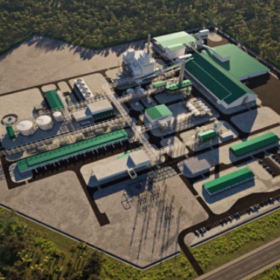
The Hydrogen Stream: Atome builds $665 million green hydrogen-based fertilizer plant in Paraguay
Atome PLC has taken Final Investment Decision on a 60,000 tpa green hydrogen-based fertilizer plant in Villeta, Paraguay. The $665 million project is financed by DFIs and equity partners and is targeting production by 2029.
