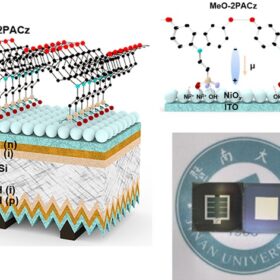
Perovskite-silicon tandem solar cell based on hybrid interconnecting layers achieves 28.47% efficiency
An international research team has designed a two-terminal perovskite-silicon tandem solar cell that utilizes new hybrid interconnecting layers to reduce recombination losses in the top perovskite device. The tandem cell achieved an impressive fill factor of 81.8%, which the scientists said is the highest value ever reported for this cell technology to date.

Coupling photovoltaics with waste-to-energy
Researchers have simulated the addition of PV plants and waste-to-energy systems in the Iraqi Al-Gharab region, that suffers from power cuts, and have identified the optimal size and locations for these hybrid plants, with the LCOE dropping by 7.7%.
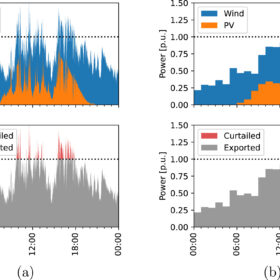
Novel approach to estimate curtailment, clipping losses in hybrid wind-solar plants
A European research team has proposed a new methodology for optimal design of hybrid wind-solar power plants. Their approach is based on 1-minute resolution data, which the scientists said provide much more accurate information about potential curtailment and clipping losses compared to 1-hour resolution data.

Radiative cooling tech based on polydimethylsiloxane film increases PV module generation by up to 3.72%
Scientists in China have proposed to use polydimethylsiloxane films doped with soda glass to reduce solar module temperature. The coating achieved solar transmittance of 94.8% and sky window emissivity of 95.3%.
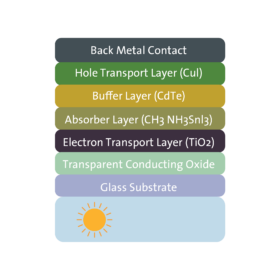
Improving perovskite solar cell performance with cadmium telluride buffer layer
An international research team has conducted a series of simulations to investigate how a cadmium telluride buffer layer may help increase efficiency and stability in perovskite solar cells. Their experiment showed that cell efficiency may climb from 11.09% to 23.56%.

New bidding strategy for PV asset owners operating in spot market
Conceived by an international research team, the new bidding strategy applies to the day-after and the intraday markets. It uses a technique that transforms results from probabilistic models into actual scenarios. Their method showed its ability to yield increased revenues and reduced imbalance.
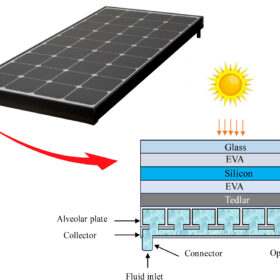
Photovoltaic-thermal panel based on channel-box heat exchanger
Scientists in Morocco have conceived a photovoltaic-thermal panel that uses a channel-box heat exchanger consisting of 94 channels attached directly to the PV module. The simulated design reportedly results in an overall panel efficiency of over 90% and good results in terms of temperature inhomogeneity.

Solid-state battery from ION reaches 800 cycles, no sign of common solid-state issues
The US solid-state battery developer announced it has achieved 800 cycles with its battery, marking significant progress towards commercialization. If this trend continues, the development holds promising potential for grid-scale projects.

Bee Solar, Huasun sign MoU to develop gigawatt-scale European supply chain
The Italian company and Huasun Energy are teaming up to produce wafers, cells and modules for the European market, with the aim to be the most cost-competitive in Europe. The two companies are working to start production in 2026.

Three-dimensional PV modules for indoor, urban locations
A research team at Korea Electrotechnology Research Institute (KERI) in South Korea is tackling the use of solar PV in non-ideal conditions with a new tool to optimize for urban and indoor PV diffuse light and partial shading conditions. The team also developed three-dimensional solar modules featuring a glass-free, lightweight design that features self-tracking that reportedly produces 60% more power compared to conventional flat modules.
