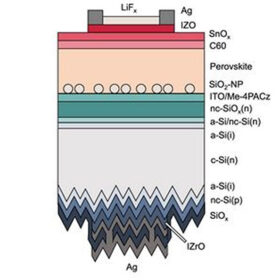
EPFL unveils perovskite-silicon tandem solar cell with certified efficiency of 30.9%
The tandem solar cell is based on a perovskite top cell treated with an additive known as 2,3,4,5,6-pentafluorobenzylphosphonic acid (pFBPA), which reportedly improves its power conversion efficiency and fill factor. The tandem device also integrates a bottom heterojunction silicon cell made with a 190-μm-thick, 2 Ω.cm, n-type, float-zone, shiny-etched monocrystalline wafer.

Improving PV module performance with thermoelectric heat storage based on PCM
Scientists in China have fabricated a prototype of a PV system integrating phase change materials, a thermoelectric generator and thermal collectors. The three technologies are intended to cool the solar panel and increase its power generation efficiency.

NREL-led consortium releases PV reliability forecasting tools
The Durable Module Materials consortium (DuraMAT) announced in its latest annual report the availability of new PV forecasting tools, and new research results towards the goal of more reliable PV modules.

Daewoo releases hybrid battery-inverters for residential PV
Daewoo’s new hybrid inverters feature LiFePO4 batteries. They are available in six variants, with power ratings ranging from 0.5 kVA to 10 kVA.
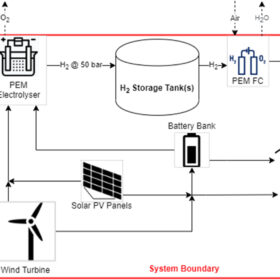
Hybrid hydrogen-battery system for off-grid PV-powered homes
Conceived by a Dutch research group, the proposed system is intended to store surplus renewable electricity via hydrogen generation and battery storage, with the latter being used only when hydrogen generation is not immediately available. Despite its high initial costs, the system can reportedly offer stable operation.

Carbon-based perovskite solar cell without hole transport layer achieves 14.15% efficiency
Researchers in China have outlined a new surface engineering strategy to build low-cost solar cells without a hole transport layer. The devices were treated with benzoylcholine halide to reduce non-radiation recombination and achieved remarkable efficiency and stability.
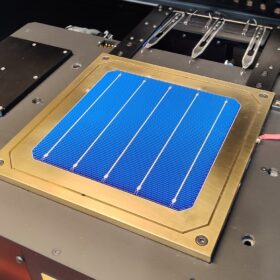
Chinese Academy of Sciences presents new way to assess HJT solar modules
Researchers in China have developed a model to predict lifetimes of heterojunction (HJT) modules made with ultraviolet cut-off polyolefin elastomer (POE) encapsulant. The approach considers factors such as temperature, humidity and UV irradiation.

All-perovskite tandem PV cell based on carboranes hits 27.2% efficiency
Researchers have developed a thermal regulation strategy to improve the performance of inverted tin-lead perovskite tech for all-perovskite tandem solar cells. It has an efficiency of 23.4% and contributed to a 27.2% efficiency in a tandem cell while ensuring stability.

IEA-PVPS launches action group on agrivoltaics
IEA PVPS is about to start a new format for expert engagement: an Action Group on Agrovoltaics; a collaborative effort to harness the synergy between agriculture and solar energy generation. Through international cooperation and interdisciplinary engagement, the group aims to unlock the potential of agrivoltaics, optimizing land use efficiency, enhancing agricultural resilience to climate change, and fostering social consensus towards solar energy development.

ETH Zurich unveils new tech to produce heat with solar
Swiss researchers have engineered a device that uses solar energy to heat to more than 1,000 C. The technology could make it possible to use solar energy to decarbonize energy-intensive industries that require high temperatures for production processes.
