
Seasonal hydrogen storage for residential self-consumption
Finnish and German researchers have assessed the role of seasonal hydrogen storage for PV prosumer households with a “least-cost” model at a global level up to 2050. They have found that seasonal hydrogen storage can only be expected in a niche, off-grid market.
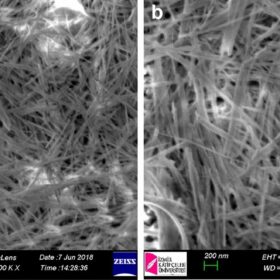
‘Natural clay’ additive promises gains in perovskite solar cell efficiency, stability
Scientists in Turkey have demonstrated that sepiolite, a naturally occurring clay substance, can be added to perovskite precursor materials, and form a scaffold layer that can improve the efficiency and stability of the cells. The scientists believe that this substance could be valuable in developing reproducible processes for the production of large-area perovskite solar cells.
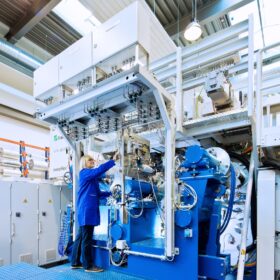
High-efficiency electrodes with ultralight current collectors
Eight industrial and scientific entities in Germany have come together to pursue two key innovations in lithium-ion battery technology: the replacement of metal foils with a metallized fabric structure, and the use of silicon as anode material.
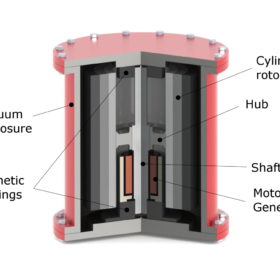
Battery hydrogen vs. battery flywheel
Scientists in Italy have looked at how flywheel storage and reversible solid oxide cells could be integrated with lithium-ion batteries in minigrids powered by solar. They found that flywheels combined with batteries could be the cheapest option for power smoothing.
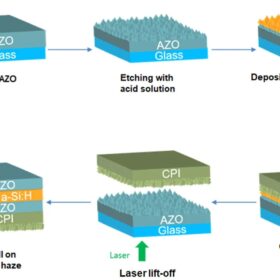
Hydrogenated amorphous silicon solar cell for BIPV, bifacial applications
Scientists in South Korea have developed a flexible, transparent solar cell with an average visible transmittance (AVT) of 88.3%. They have also created an n-type rear window layer to optimize bifacial operation.
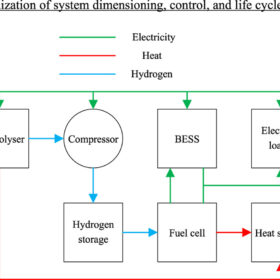
How to combine offgrid PV, heat pumps, and fuel cells in residential complex
Finnish researchers have studied different scenarios to convert a Nordic oil-heated townhouse into a carbon-neutral building. They dimensioned an off-grid PV-powered heat pump system using waste heat recovery from a hydrogen storage system and calculated its life-cycle cost. They concluded that the solution is less profitable than grid-connected systems.
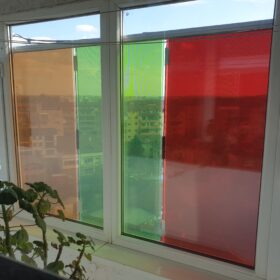
Cadmium telluride PV windows for domestic hot water production
Romania-based startup Photovoltaic Windows has developed an off-grid domestic hot water system powered by cadmium telluride (CdTe) photovoltaic semi-transparent glasses. It claims a 0.7 kW pilot installation on an apartment balcony in Bucharest resulted in annual savings of €1,100 ($1,202).
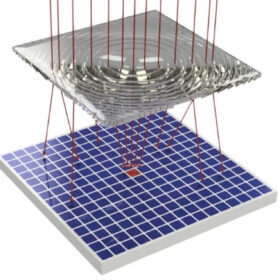
Taiwanese scientists develop high-concentration PV system
Taiwanese researchers have developed a system featuring a 2 × 2 Fresnel lens array and a solar panel made of III-V materials and polycrystalline solar cells, with low light leakage.
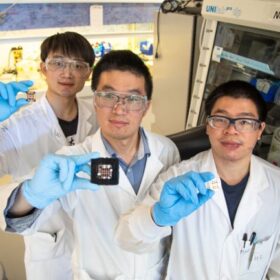
Triple junction perovskite solar cell hits 24.3% efficiency
An international research group created a triple-junction perovskite solar cell with an efficiency of 24.3% and a quasi-steady-state efficiency of 23.3%. The prototype cell, which has been independently certified by the US National Renewable Energy Laboratory (NREL), features rubidium/cesium mixed-cation inorganic perovskites with a bandgap of around 2.0 eV to suppress light-induced phase segregation.
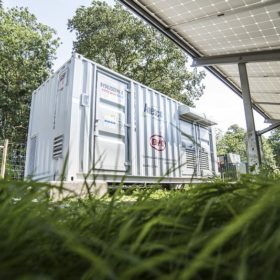
IndiGrid commissions first solar-storage project
IndiGrid has commissioned a pilot project featuring a solar panel bank coupled with a battery energy storage system (BESS), at its Dhule substation in the Indian state of Maharashtra.
