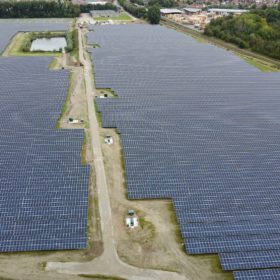
Shell to purchase 100 MW UK portfolio from Anesco
Shell will purchase four planned PV projects totaling 100 MW in various locations across northern England. It says it will seek offtakers for the projects through its power trading team and sees strong demand in the corporate power purchase agreement sector.
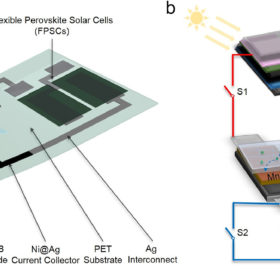
New battery needs seconds of sunlight to keep wearables charged
Researchers at Surrey’s Advanced Technology Institute have demonstrated a new, highly integrated, flexible photo-rechargeable system based on zinc-ion batteries and perovskite solar cells. It only needs a few seconds of sunlight to keep smart wearables charged.

Backward ray tracing for fast energy yield simulations
Scientists in the Netherlands have developed a model to forecast the energy yield of a PV system. It is able to take into account factors such as partial shading and multiple module orientations. Tested against a reference cell and pyranometer, the model showed less than 5% error, and the scientists claim their approach is up to three orders of magnitude faster than more common approaches using complex ray tracing.
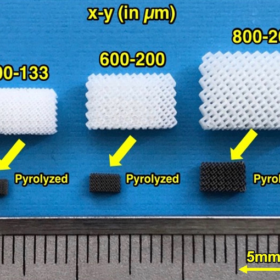
Micro-engineered, high-performing anode for sodium-ion batteries
Scientists in Japan have demonstrated sodium-ion batteries using hard carbon microlattices, produced with an inexpensive 3D printer. In addition to reducing the battery size and slashing manufacturing costs, the resulting anode allows fast transportation of energy-generating ions.
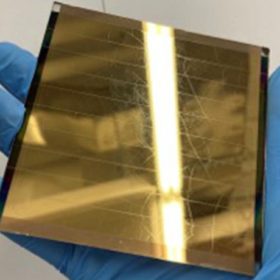
Light-scattering structures to boost solar performance
An international team of scientists developed a nanoparticle structure which, when added to a solar cell, was shown to scatter light and potentially reflect it many times within the cell, contributing to a noticeable jump in current.

Magnesium superionic conductor for lithium-free solid-state batteries
Scientists in Japan have developed a novel metal-organic, framework-based magnesium ion conductor with superionic conductivity, even at room temperature.
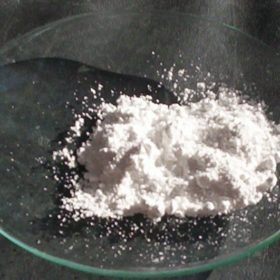
N-type solar cell with aluminum-titanium passivating contact achieves 21.9% efficiency
Scientists in Australia have demonstrated a new way to apply a passivating contact layer to silicon cells. They produced an n-type cell with aluminum-titanium passivating contact and 21.9% efficiency, and claimed the technique could open up new possibilities for the use of transition metal oxides in cell passivation.
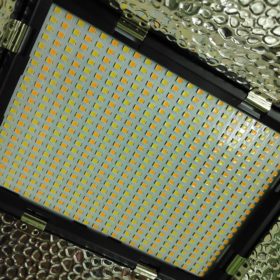
Solar-plus-storage for LED lighting in commercial buildings
Indian researchers claim that commercial buildings with LED lighting could gain energy independence by installing standalone solar-plus-storage systems. They said a 914.4 kW PV system linked to lithium-ion batteries could be enough to power an entire building with an estimated annual demand of 190,830.7 kWh.
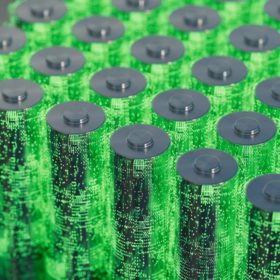
High-performance aqueous calcium-ion battery
Researchers from Rensselaer Polytechnic Institute in the United States have developed a special class of materials for bulky calcium ions, providing pathways for their facile insertion into battery electrodes.
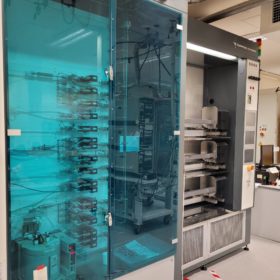
Improving gettering tech for TOPCon solar cells
Scientists in Australia have looked at how gettering technologies could improve passivating contacts based on polysilicon and silicon monoxide (SiOx) for tunnel oxide passivated contact (TOPCon) solar cells. They found that the gettering strength of the P-doped poly mainly depends on the doping concentration.
