
Pure solid state batteries from Switzerland
Swiss Clean Battery is set to start commercial production of its pure solid state batteries in Switzerland. The batteries are based on a protected electrolyte made of a solid ion conductor, which helps to maintain internal resistance and capacity. The fixed ion conductor is formed in the battery cell itself, similar to a multi-component adhesive.
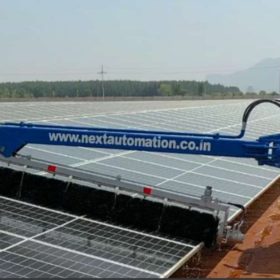
Tractor-mounted, hydraulic panel cleaning arm for solar farms
India’s Next Automation has developed a tractor-mounted hydraulically operated arm as a cleaning solution for panels in solar farms.
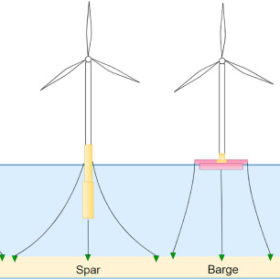
Renewable offshore floating hydrogen production
Scottish Development International and J-DeEP are developing a floating offshore hydrogen production plant off the coast of Scotland. Research shows the combination of large-scale offshore renewables and floating hydrogen production could soon become viable, depending on the project configuration.
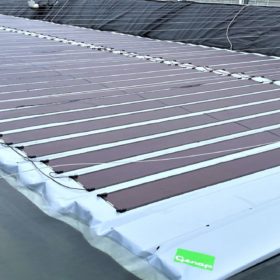
Lightweight solar for agricultural water reservoirs
The Genap Energy Cover uses HyET Solar Powerfoil thin-film solar modules, rated at 12.0% efficiency, for agricultural water storage and reservoirs, with an initial focus on the greenhouse and horticulture markets in the Netherlands. Genap said a 12kWp test setup had a generation density of 60W/m2, rising to 120W/m2 within a year, with an eventual target of 165W/m2.
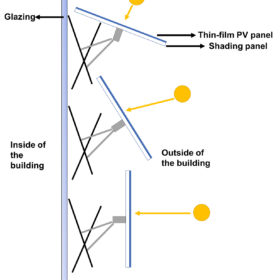
Designs, control strategies for PV-integrated shading devices
Photovoltaic shades in buildings offer energy efficiency and electricity generation, but an international research group says their commercial viability will depend on the control strategies used to optimize performance.

Could ‘hot carrier’ solar cells break the theoretical efficiency limit?
Up to 50% of the energy absorbed by a solar cell is lost as heat. Scientists are now developing a third generation of “hot carrier” solar cells that take advantage of this heat, potentially breaking the Shockley-Queisser limit of silicon-based PV.
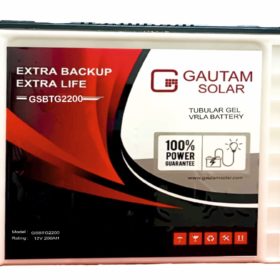
Gautam Solar releases gel battery solution for solar storage
India’s Gautam Solar says its gel batteries provide a safer, cost-effective, and long-lasting alternative for the energy storage space.
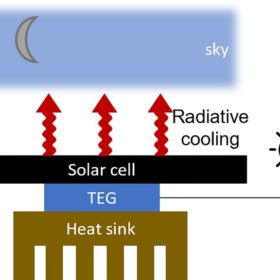
Radiative cooling-based solar cell with 50 mW/m2 of generation at night
Stanford University scientists have developed a solar cell with 24 hours of power generation via an embedded thermoelectric generator, which extracts power from the radiative cooler at night. Extra daytime power from excess heating comes from the cell itself.

SMA unveils new inverter for residential, commercial PV
SMA is offering a new line of four inverters with power ratings of 12kW, 15kW, 20kW and 25kW, for use in rooftop PV systems up to 135kW in size. It claims the inverters provide grid-compliant power control of entire systems and enable over-dimensioning of PV arrays by up to 150%.
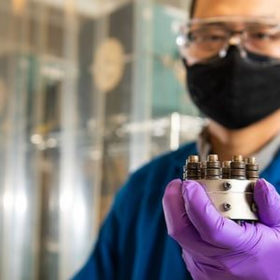
Aluminum-nickel molten salt battery for seasonal renewables storage
US scientists have developed a battery that can retain 92% of its initial capacity over periods of 12 weeks, with a theoretical energy density of 260 W/hour per kg. It was built with an aluminum anode and a nickel cathode, immersed in molten-salt electrolyte.
