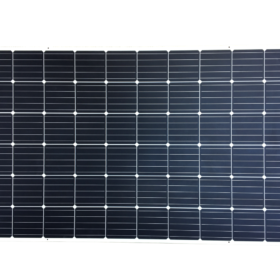
Solar module for lightweight applications from France
French manufacturer 2CA has developed a 20%-efficient solar module that weighs four times less than a glass-glass module of the same size. It claims the frameless, self-supporting panel could be used for lightweight applications at military camps and other remote locations.
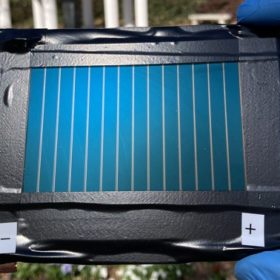
Automatically generated databases for perovskite, dye-sensitized solar cells
University of Cambridge scientists have created new databases for dye-sensitized and perovskite cells, respectively. They used the ChemDataExtractor text-mining toolkit to collect the data.

Large-area graphene-perovskite solar modules with better temperature coefficient
An Italian-Greek research group has developed a large-area perovskite solar panel with graphene-doped electron transporting layers. With increasing temperatures, the module exhibits a smaller drop in open-circuit voltage than commercially available crystalline silicon panels.
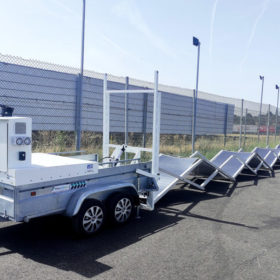
Retractable solar trailer from Spain
PolarGreen Tow is a portable PV system with a capacity of up to 6.5 kW. It can be used to supply power for electric cars or remote locations, or to provide energy during blackouts.
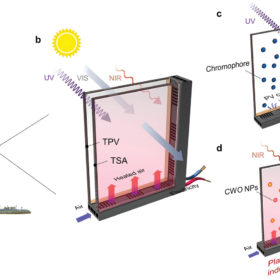
Solar window generates electricity, thermal energy
A research team in Hong Kong has built a solar window that can generate power on the external side via a luminescent solar concentrator and thermal energy on the internal side via transparent solar absorbers.

The Hydrogen Stream: Volvo starts testing fuel cell electric trucks
Volvo said it will offer fuel cell electric trucks by the second half of the decade, while an airport in northern Japan has started working on a feasibility study for local hydrogen production. Uruguay, meanwhile, has presented a new hydrogen strategy.
Business models for Swedish solar
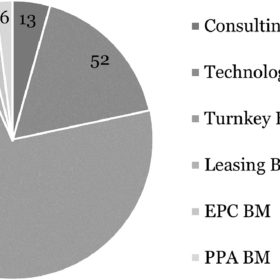
Swedish researchers have identified six business models for the country’s solar market and highlighted how companies differ significantly in their approaches from policymakers and scientists. They analyzed data from 241 solar companies.
Harvard, Cambridge scientists improve durabiliy of redox flow batteries with anthraquinone
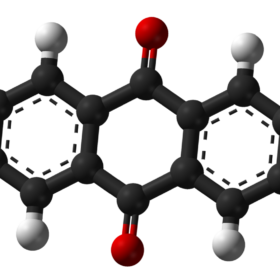
A research team has used a molecule known as 2,6-dihydroxy-anthraquinone (DHAQ) to improve the durability of organic aqueous redox flow batteries. They claim the molecule enables a net lifetime that is 17 times longer than past research has shown.
Open-source online platform shows how Europe may become energy-independent with renewables by 2050
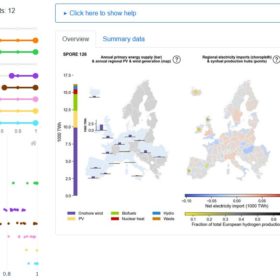
European researchers have developed an open-source online tool that can identify areas where renewable energy and synthetic fuels can be cost-effectively produced, where hydrogen hubs could be built, and where grid expansion is needed. It can be used in different sectors across 35 countries.
Servotech tests solar monitoring device along with PV Port in Germany
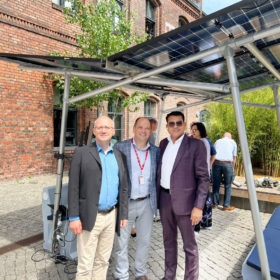
Servotech has successfully tested its ComPort solar monitoring device with the PV Port portable PV system at the EUREF-Campus in Berlin.
