
Iberdrola moves forward with Portugal’s largest pumped-hydro storage project
The Spanish energy company is building a huge hydropower complex across three water reservoirs in northern Portugal. The project will rely on 880 MW of pumped-hydro storage and is expected to become fully operational in 2024.
Storing solar power with grid-scale molten hydroxide
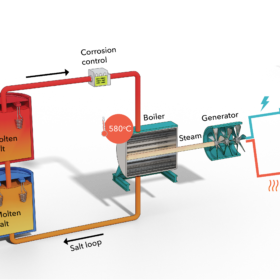
Seaborg Technologies, a Danish manufacturer of molten salt nuclear reactors, has turned a technology that was originally developed for nuclear power into a large-scale storage solution for wind and solar. It has developed a storage system that uses renewable energy to heat salt with electrical heaters, based on two-tank molten salt storage designs developed for concentrated solar power plants.
Grazing animals increase carbon sequestration by up to 80% in PV projects
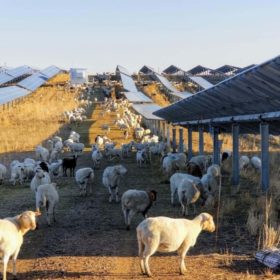
Temple University researchers have found that managed sheep grazing on an acre of recovering agricultural soil with native plants may sequester 1 ton of carbon per year, which could accumulate for 12 to 15 years before reaching saturation.
German consortium develops 19.7%-efficient PERC solar cells made of recycled silicon
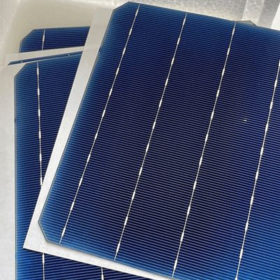
Led by German research institute Fraunhofer ISE, the consortium has built the solar cells with 100% crystalline silicon recycled from end-of-life photovoltaic panels. The silicon is recycled through a technique conceived by German specialist Reiling GmbH & Co. KG and the Fraunhofer Center for Silicon Photovoltaics CSP.
Robot dog for PV plant monitoring
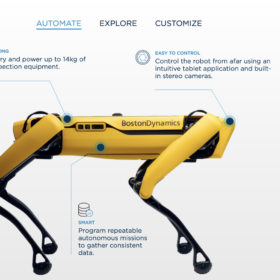
Spanish renewable energy company Acciona is using a robot dog, instead of drones, to monitor a solar park in northern Chile. The device has a built-in thermal vision system that generates thermographic reports on the status of the different PV plant components, as it walks between the panel rows following a programmed route.
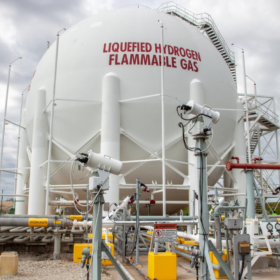
Large-scale storage options for compressed hydrogen
Researchers from Finland and Sweden have reviewed different ways to store compressed gaseous hydrogen, including storage vessels, geological storage, and other underground options.

Photovoltaics for curved surfaces
Researchers in Japan have used heat-shrinkable polymers to laminate organic photovoltaics onto curved surfaces. The process improves efficiency while minimizing damage to photovoltaic components.
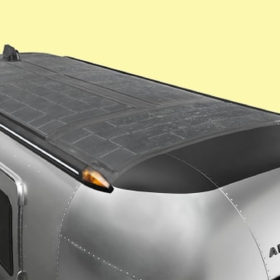
Solar-powered camper from Airstream is a two-wheeled electric car
The camper can be driven and parked without the use of a car, is integrated with solar, and optimized for the electric vehicle revolution.
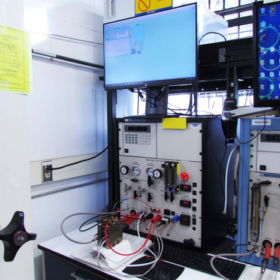
The Hydrogen Stream: New fuel cell design to solve longstanding problem of overheating
Los Alamos National Laboratory researchers developed a new polymer fuel cell that is claimed to solve the long-known issue of overheating. Furthermore, Mexican cement producer Cemex invested in HiiROC, a UK-based hydrogen production startup, which developed a scalable technology that uses thermal plasma electrolysis to convert biomethane, flare gas, or natural gas into hydrogen at a reportedly lower cost than competing solutions.

Forget batteries, what if surplus renewable energy could be stored as information?
A pair of researchers from UC San Diego has proposed to precompute certain data when the grid is flooded with solar or wind power, and then store it on servers for later use.
